
The Four Quadrants-Time Management

There is a technique to help prioritize your tasks, and clear your mind. The four quadrants is used to help to be more efficient, but more importantly identify those tasks required to complete first.

Personally, I first heard of this concept through Stephen Covey’s ‘Seven Habits of Highly Effect People.’ The matrix is known as the
Eisenhower’s Urgent-Important Principle.

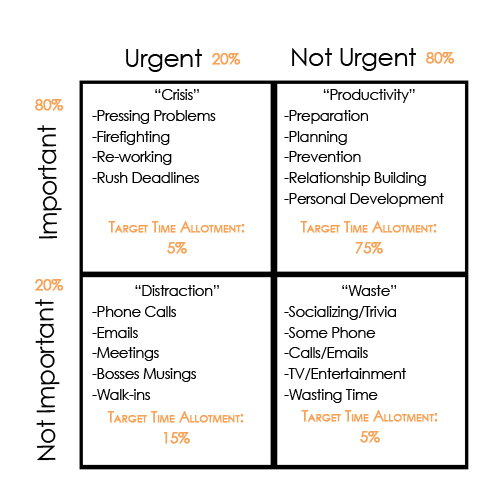
The Four Quadrants of Time Management

The quadrants can be created on any piece of paper. They are sectioned off as:

Defining the Quadrants

Q1: Urgent and important

Q2: Not urgent but important

Q3: Urgent but not important

Q4: Not urgent and not important


[mc4wp_form id=”121652″]

You want to place your high priority items in quadrant one. Your want-to-do or can wait items are in quadrant four.

I have seen another way to view these quadrants are below:

  • Important and Urgent – Crises and Emergencies
  • Important but Not Urgent – Prevention, Planning, and Improvement
  • Not Important but Urgent – Interruptions and Busy Work
  • Not Important and Not Urgent – Time Wasters

The important thing to keep in mind is honesty. “Am I doing this because it is truly important or am I doing this because it is urgent?”

Matt Cole has high regard for knowledge share. He has a desire to share critical thinking and information. With a Masters in Information Technology and a wide array of certifications, while not working full-time, he wishes to knowledge share through providing insight, information organization, and critical thinking skills.

#KnowledgeShare | Matt Cole | #infobyMattCole

Similar Posts

  • Gathering Data

    Gathering data is a critical aspect of project planning that helps project managers make informed decisions and ensure project success. Data collection provides valuable insights into project performance, identifies potential risks and issues, and facilitates continuous improvement. In this article, we will discuss the importance of gathering data in project planning and provide tips for…

  • Laws of Priority

    The “laws of priority” are a collection of principles and frameworks that guide effective task management, emphasizing impact over activity volume. They highlight that busyness ≠ productivity, as productivity stems from focusing on high-value tasks rather than merely staying occupied. Here are key principles often associated with prioritization: 1. Pareto Principle (80/20 Rule) 2. Eisenhower Matrix 3. Parkinson’s Law 4. Opportunity…

  • Decline Reading Proficiency Continues for Kids

    It is estimated that 67% of fourth-grade students do not read proficiently at their grade level. Only one-third of high school seniors are considered proficient readers, and only 4% of seniors reached the highest level of advanced proficiency in reading on a recent test. In fact, only 39% of teacher preparation programs across the nation…

  • Defining the Problem

    Defining the problem is the first step in creating a successful project plan. Without a clear understanding of the problem, it’s impossible to develop a comprehensive plan that will address the root cause of the issue. In this article, we will discuss the importance of defining the problem and provide tips for effective problem definition….

  • Blocks of Time

    I came across a YouTube video conveying an idea, I really like, which led to an interesting article, that led to action taken on the idea. How did I end up here? Let me back up. My wife’s birthday is coming up and she is a hardcore paper journal, day keeper. I have tried to…