
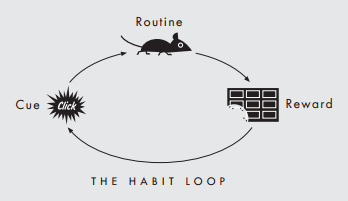
Cycle of the Habit
By definition a habit a recurrent, often unconscious pattern of behavior that is acquired through frequent repetition.
A more psychological definition is,
Psychology Today
A long-standing pattern of learned behavior; often contrasted with a specific way. See SET. set, which is a temporary or recently Habit is one of the most pervasive of all aspects of behavior. We develop habitual ways of thinking, feeling, talking, walking, and perceiving. All our characteristic attitudes, reactions, verbal patterns, gestures, facial expressions, and mannerisms fall into this category.
Notice two things involving a habit.
- It has become a unconscious behavior (we don’t recognize it).
- It is a ‘learned’ behavior.
This would indicate we could step back and identify it, then relearn a new behavior, replacing it.
What differentiate a good versus bad habit is how it effects the individual and those around.
The Habit Loop
The book ‘The Power of Habit’ by Charles Duhigg’s, goes into detail with the habit loop.
A habit has three parts to make the whole.

- The Cue
- The Routine
- The Reward
The cue or trigger activates the routine. The routine is the action the individual takes from the cue. The reward is the brain feeding you the ‘feel-good’ chemical, endorphine.
Breaking the Loop
Before we can even begin to disrupt this unconscious behavior, we first need to identify the trigger and routine.
This is very difficult, due to being an unconscious reaction. However, once you identify the cue (trigger), you can assess your response (routine).
You can never truly remove a habit. However, you can identify the cue, then change the routine for your reward.
Aristotle
“We are what we repeatedly do. Excellence then is not an act but a habit.”
This means replacing the self-inflicting routine with a rehabilitating routine. While we cannot remove the cue, we can definitely replace our response toward it.
Identifying the Cue (Trigger)
The five categories or groups a trigger is hidden are:
- Location
- Time
- Emotional State
- Other People
- Immediately Preceding Action
Identifying the Routine
The routine is the obvious action taking place, you want to change. This self-indulgent or self-inflicting action should be easily identified. Ask yourself, what is the routine. Then, step back, and find the trigger. Once you identify these two components, you can break the cycle.
Identifying the Reward
Know we have the cycle identified, the reward should be identified. This can be less obvious. The reward can be a feeling, shot of adrenaline, change of scenery, even sweets.
The idea here is to experiment with the reward. Rather than eat that sweet, go for a walk around or other action as a reward.
Helping Find the Pattern
As you test four or five different rewards, you can use an old trick to look for patterns: After each activity, jot down on a piece of paper the first three things that come to mind when you get back to your desk. They can be emotions, random thoughts, reflections on how you’re feeling, or just the first three words that pop into your head.
The reason why it’s important to write down three things – even if they are meaningless words – is twofold. First, it forces a momentary awareness of what you are thinking or feeling. What’s more, studies show that writing down a few words helps in later recalling what you were thinking at that moment. At the end of the experiment, when you review your notes, it will be much easier to remember what you were thinking and feeling at that precise instant, because your scribbled words will trigger a wave of recollection.
How Habits Work
Let me know how you found your pattern, and changed it for the better. Love to hear from you.
Matt Cole has high regard for knowledge share. He has a desire to share critical thinking and information. With a Masters in Information Technology and a wide array of certifications, while not working full-time, he wishes to knowledge share through providing insight, information organization, and critical thinking skills.
#KnowledgeShare | Matt Cole | #infobyMattCole