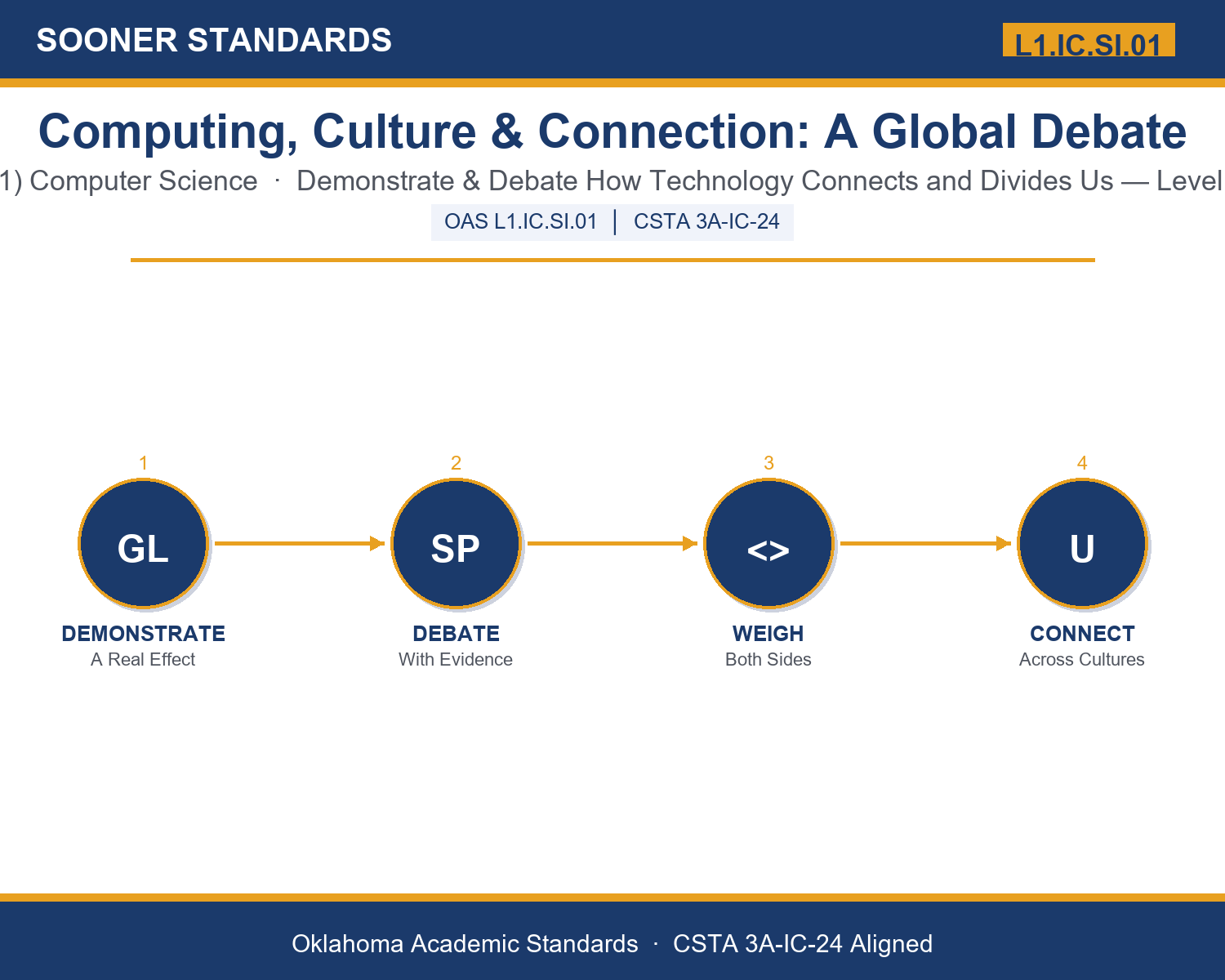
Teaching Computing, Culture & Connection: A Global Debate in Grades 9-10 (Level 1): Oklahoma Standard L1.IC.SI.01
Teaching Computing, Culture & Connection: A Global Debate in Grades 9-10 (Level 1): Oklahoma Standard L1.IC.SI.01
Teaching technology and culture in grades 9-10 (level 1) does not have to be complicated. Picture a diaspora family using a shared messaging app to keep their home language and traditions alive across three countries. That kind of thinking is exactly what Oklahoma's grades 9-10 (level 1) computer science standard L1.IC.SI.01 asks students to practice — and it is very teachable with the right materials. This post walks through what the standard means, the misconceptions students bring to it, and discussion starters you can use tomorrow, whether you teach in a classroom or at your kitchen table.
What Does Standard L1.IC.SI.01 Actually Ask?
Demonstrate and debate how computing increases and decreases connectivity and communication among people of various cultures. — Oklahoma Academic Standards for Computer Science (February 2023)
In plain language: This standard asks Level 1 students (grades 9-10) to show specific, real examples of how computing technology increases and decreases connection and communication between people of different cultures, and to debate, using evidence, which effect is bigger or more important.
In student-friendly terms, the learning target is: "I can demonstrate a specific example of how computing increases or decreases connectivity and communication among people of different cultures, and debate the effect using evidence."
What Students Should Be Able to Do
- I can name a specific technology and explain exactly how it increases cross-cultural connectivity.
- I can name a specific technology and explain exactly how it can decrease genuine cross-cultural communication.
- I can build a debate argument that takes a position, uses evidence, and responds to a counterargument.
- I can explain how the digital divide affects who experiences computing's benefits and harms.
Along the way, students pick up the working vocabulary of the topic: connectivity, globalization, bandwidth, latency, asynchronous, synchronous, translation, accessibility, infrastructure, misinformation, stereotype, diaspora, censorship, platform.
Technology And Culture: Misconceptions to Watch For
These are the wrong turns students reliably take with this standard — knowing them ahead of time is half the lesson plan. Each correction strategy below comes straight from the unit's teacher guide (the paragraph and activity references point into the unit itself).
1. "Computing simply connects people, full stop, with no downside."
Return to paragraph 4. Ask students to name a platform they use and identify one real harm it can cause, not just its benefits — misinformation and censorship are both demonstrable, real effects.
2. "A debate argument should only present one side to sound confident."
Point to paragraph 5. The strongest arguments name specific evidence on both sides and directly address the counterargument; ignoring the other side actually weakens a debate position.
3. "Everyone experiences computing's global effects the same way."
Revisit paragraph 6's digital divide discussion. Access to infrastructure and bandwidth is uneven, so the same technology can barely reach one community while transforming daily life in another.
4. "Misinformation and honest information spread through different, separate channels."
Emphasize paragraph 4: misinformation travels through the exact same networks, at the same speed, as accurate information — the technology does not distinguish between them.
Discussion Starters You Can Use Tomorrow
- Think of a platform you use daily. Name one specific way it increases connectivity and one specific way it could decrease genuine communication.
- Why might a strong debater argue that translation technology's benefits outweigh its harms, while an opponent argues the opposite? What evidence would each side use?
- Describe a real or hypothetical situation where the digital divide meant one community experienced computing's benefits while another mostly experienced its risks.
Bringing It Home
This topic is a natural one for families. One ten-minute activity to try: Together, pick one app or website your family uses to communicate with someone far away. Ask your student to describe one specific way it helps your family stay connected, and one specific way that same kind of technology could cause a misunderstanding or spread false information. There are no wrong answers — the goal is hearing their reasoning on both sides.
Where This Leads
Students who can demonstrate a specific example of how computing increases or decreases connectivity and communication among people of different cultures, and debate the effect using evidence are building skills used every day in localization engineering, trust and safety / platform policy, journalism and fact-checking, user experience research, and international relations.
See the Unit in Action
Get the Complete L1.IC.SI.01 Unit
I built a complete, no-prep unit for this standard — How Computing Connects and Divides Us: Debating Global Communication — covering 3-4 days of instruction across 43 pages:
- Teacher guide — day-by-day pacing, misconceptions to watch for, discussion questions, differentiation for support / ELL / extension, and a 4-point rubric
- Student learning target page — a kid-friendly "I can" statement with success criteria
- Full content lesson with 3 embedded "Check Your Understanding" checkpoints
- 12-question assessment (6 multiple choice, 4 true/false, 2 short answer) with a complete answer key, explanations, and exemplar responses
- Group activity — "Global Connectivity Debate: Demonstrate & Argue" (25-30 minutes)
- Individual activity — "My Connectivity Case Study" (20 minutes)
- Crossword and word search built from all 14 vocabulary terms (with answer keys)
- Family connection letter — a plain-language page for parents, with dinner-table questions and a 10-minute home activity
- Certificate of achievement — ready to sign and send home
- Debate Prep Cards: Global Connectivity Debate (separate printable, 2 pages)
- Reference Sheet: Building a Debate Argument (separate printable, 1 page)
- My Connectivity Case Study (separate printable, 2 pages)
Get Computing, Culture & Connection: A Global Debate on Teachers Pay Teachers →
Also aligned to CSTA 3A-IC-24: Evaluate the ways computing impacts personal, ethical, social, economic, and cultural practices.
Every Sooner Standards resource is built directly from the official Oklahoma Academic Standards for Computer Science (February 2023) — standard text verified, never paraphrased from memory.