Every Book a Teacher?

     Understanding the current society feeds on quick intel, and just give me the bullet points attitude, few take the time to dig deeper. We are shortchanging and depriving ourselves. 

Every book we read is a potential teacher. Reading is a systematic process for learning the essential meanings of that teacher. When we become good readers, we can learn the essential meanings of an unlimited number of teachers whose teachings live on, ever available, in the books they have written.

Richard Paul and Linda Elder

How to Read a Paragraph: The Art of Close Reading
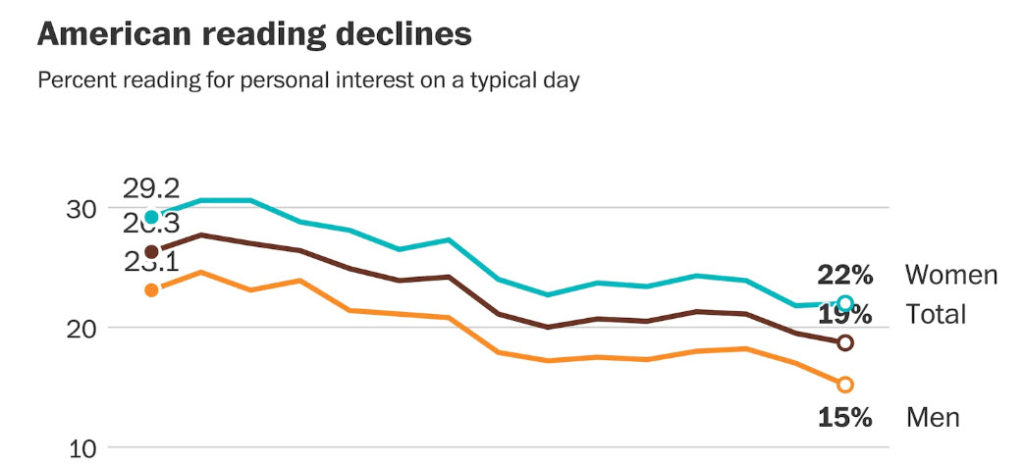
Yet fewer individuals are reading. A steady drop shown above 2003 to 2017, provides us this visual on the decline. This chart represents casual reading, never mind deep reading for critical thinking or understanding.

Where does this lead us?

This in mind, we truly see a depreciation in mental clarity, involving critical thinking skills. 

One may argue we are still learning, through visual content.

However, studies show if we replace paper reading with digital content we lose tactile and physical growth. 

"There is physicality in reading," says developmental psychologist and cognitive scientist Maryanne Wolf of Tufts University, "maybe even more than we want to think about as we lurch into digital reading—as we move forward perhaps with too little reflection. I would like to preserve the absolute best of older forms, but know when to use the new."

The Reading Brain in the Digital Age: The Science of Paper versus Screens

With this Covid 19 lock down, affecting all, it would be a great time to grab a book and dive in. 

You may find your new teacher.

Similar Posts

  • Decline Reading Proficiency Continues for Kids

    It is estimated that 67% of fourth-grade students do not read proficiently at their grade level. Only one-third of high school seniors are considered proficient readers, and only 4% of seniors reached the highest level of advanced proficiency in reading on a recent test. In fact, only 39% of teacher preparation programs across the nation…

  • Defining the Problem

    Defining the problem is the first step in creating a successful project plan. Without a clear understanding of the problem, it’s impossible to develop a comprehensive plan that will address the root cause of the issue. In this article, we will discuss the importance of defining the problem and provide tips for effective problem definition….

  • Proximate Cause

    Reading Nir Eyal book, #Indistractible , the term proximate causes is discussed in chapter three. By definition, proximate cause is “an event which is closest to, or immediately responsible for causing, some observed result.” This is also known as a distal (away from the center/outer part) cause. In other words, it is observed and at first…

  • Perfection and Excellence

    Perfection and Excellence “Perfection has to do with the end product, but excellence has to do with the process. ” Jerry Moran Tweet Listen to the Episode Tasks and process deals with the actions providing an end goal. Depending on how well those tasks are completed affects the end goal. Even the smaller tasks will…