First 'Living' Robots via Stem Cells?
Utilizing supercomputers, scientists are now using frog stem cells in constructing the first living robots.
By assembling cells from African clawed frogs into tiny robots, the living robots will be able to move, regenerate, and carry payloads. These are living programmable organisms.

Shown here is a Xenobot with four legs.
While they can regenerate and move around on their own energy, if damaged or when the tasks is completed, they simply fall apart and disintegrate due to being biodegradable.
How these Living Robots walk
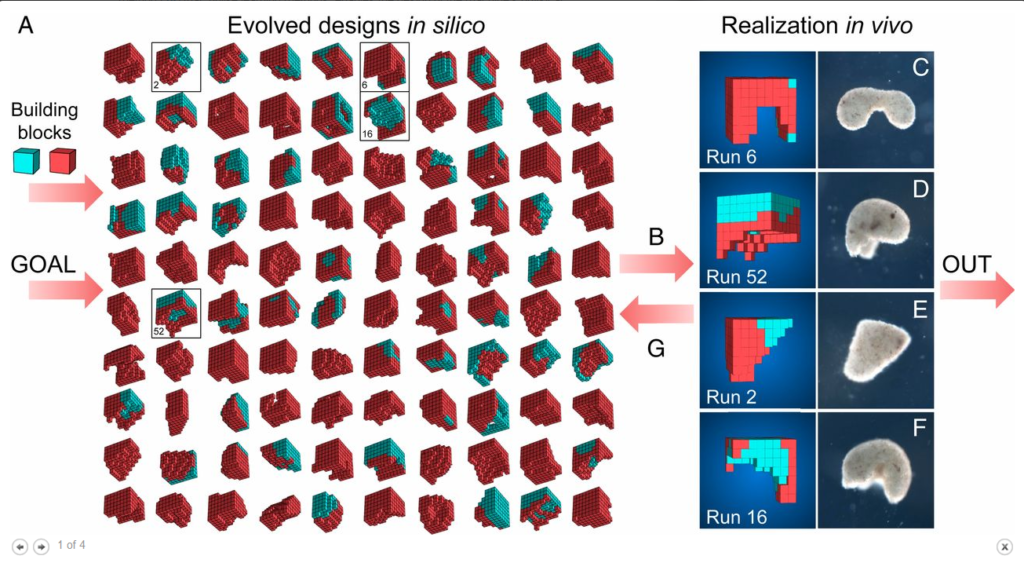
- Using an evolutionary algorithm, thousands of random designs are made, while simulating passive skin cells and active heart cells contracting.
- The algorithm is then used to design a method for specific tasks such as straight line walking, moving in specific format, Ect.
How Big are These?
According to news source, “These are very small, but ultimately the plan is to make them to scale,” said Levin.
Xenobots might be built with blood vessels, nervous systems and sensory cells, to form rudimentary eyes. By building them out of mammalian cells, they could live on dry land.
The term Xenobots is derived from the African clawed frogs, Xenopus laevis.
By building these up to more complicated scale, scientist are learning “the software of life”, Levin said. [Source]
This research is funded by the US Defense Advanced Research Projects Agency’s lifelong learning machines programme, which aims to recreate biological learning processes in machines.
Thoughts
I take a look at the ethical side of this advancement in my personal site. The article is titled, Ethical View: Xenobots.

Matt Cole has high regard for knowledge share. He has a desire to share critical thinking and information. With a Masters in Information Technology and a wide array of certifications, while not working full-time, he wishes to knowledge share through providing insight, information organization, and critical thinking skills.
#KnowledgeShare | Matt Cole | #infobyMattCole