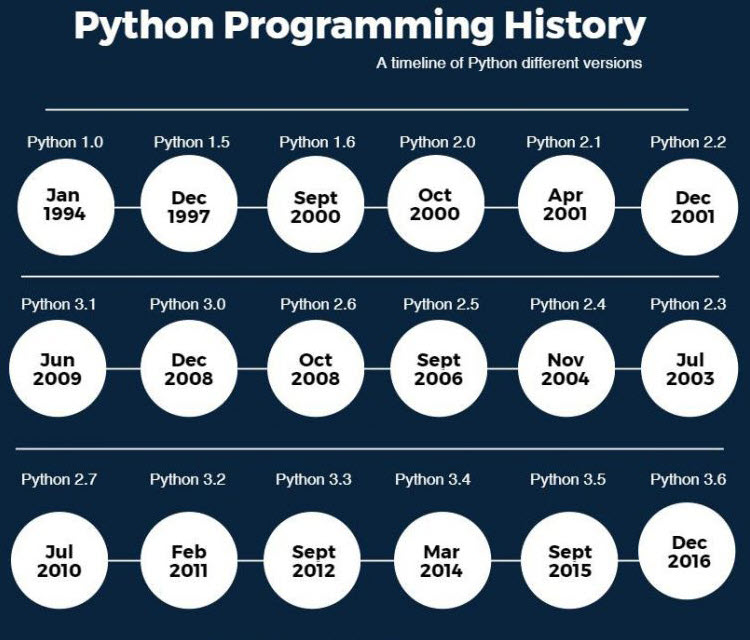
Python Programming Language History

Python is a widely used general-purpose, high-level programming language. Python was initially designed by Guido van Rossum in 1991 and developed by Python Software Foundation. It was mainly developed for emphasis on code readability, and its syntax allows programmers to express concepts in fewer lines of code.

Guido Van Rossum began doing its application based work in December of 1989 by at Centrum Wiskunde & Informatica (CWI) which is situated in Netherland. Originally, the creation of Python was his hobby over Christmas.

Guido had worked on the language ABC Programming Language. This language had issues, which Guido corrected. Extracting the positives, he created Python.

The inspiration for the name came from BBC’s TV Show – ‘Monty Python’s Flying Circus’, as he was a big fan of the TV show and also he wanted a short, unique and slightly mysterious name for his invention and hence he named it Python!

The Python language was finally released in 1991. When it was released, it used a lot fewer codes to express the concepts, when we compare it with Java, C++ & C. Its design philosophy was quite good too. Its main objective is to provide code readability and advanced developer productivity. When it was released it had more than enough capability to provide classes with inheritance, several core data types exception handling and functions.

#LearningPython

Learning Python Course

With Python’s inception, it was an inspiration for additional coding languages, such as Ruby, Cobra, Boo, CoffeeScript ECMAScript, Groovy, Swift Go, OCaml, Julia etc.
Matt Cole has high regard for knowledge share. He has a desire to share critical thinking and information. With a Masters in Information Technology and a wide array of certifications, while not working full-time, he wishes to knowledge share through providing insight, information organization, and critical thinking skills.

#KnowledgeShare | Matt Cole | #infobyMattCole
Similar Posts

  • The Paideia Method

    The Paideia method is an educational approach that emphasizes the development of critical thinking skills, effective communication, and personal growth. The term Paideia comes from the Greek word for education and represents a holistic approach to learning that aims to cultivate well-rounded individuals. The Paideia method was developed by Mortimer Adler and other educators in…

  • Mental Maps – Neuro-Linguistic Programming

    Mental maps are a key concept in neuro-linguistic programming (NLP), a psychotherapy approach that aims to help people change their behavior and thinking patterns by changing the language they use to describe their experiences. In NLP, mental maps refer to the subjective constructs that people create to make sense of their experiences. These maps are…

  • What is Shadow Banned?

    There is the term shadow banned being used for the social platform. You may hear from some content creators, ‘I have been shadow banned’ or ‘I no longer get notified when you put content out, you are being shadow banned.’ But what exactly does it mean? By definition, Shadow banning (also called stealth banning, ghost…

  • Monitor and Control Project Progress

    Monitoring and controlling project progress is a critical aspect of project management. It involves tracking the project’s performance against the project plan, identifying deviations from the plan, and taking corrective actions to keep the project on track. In this article, we will discuss the key steps involved in monitoring and controlling project progress, the importance…

  • Challenge Yourself

    Being a polymath means having expertise in multiple fields, but it also means challenging yourself to continually expand your knowledge and skills. The polymath mindset involves embracing challenges and pushing yourself out of your comfort zone to explore new areas of interest. One of the benefits of challenging yourself as a polymath is that it…

  • Identifying the Stakeholders

    Identifying stakeholders is a crucial step in any project or business initiative. This step in project management is crucial. Stakeholders are individuals or groups who have an interest in or may be affected by, the project or initiative. Identifying stakeholders helps to ensure that their needs and expectations are taken into account during project planning…