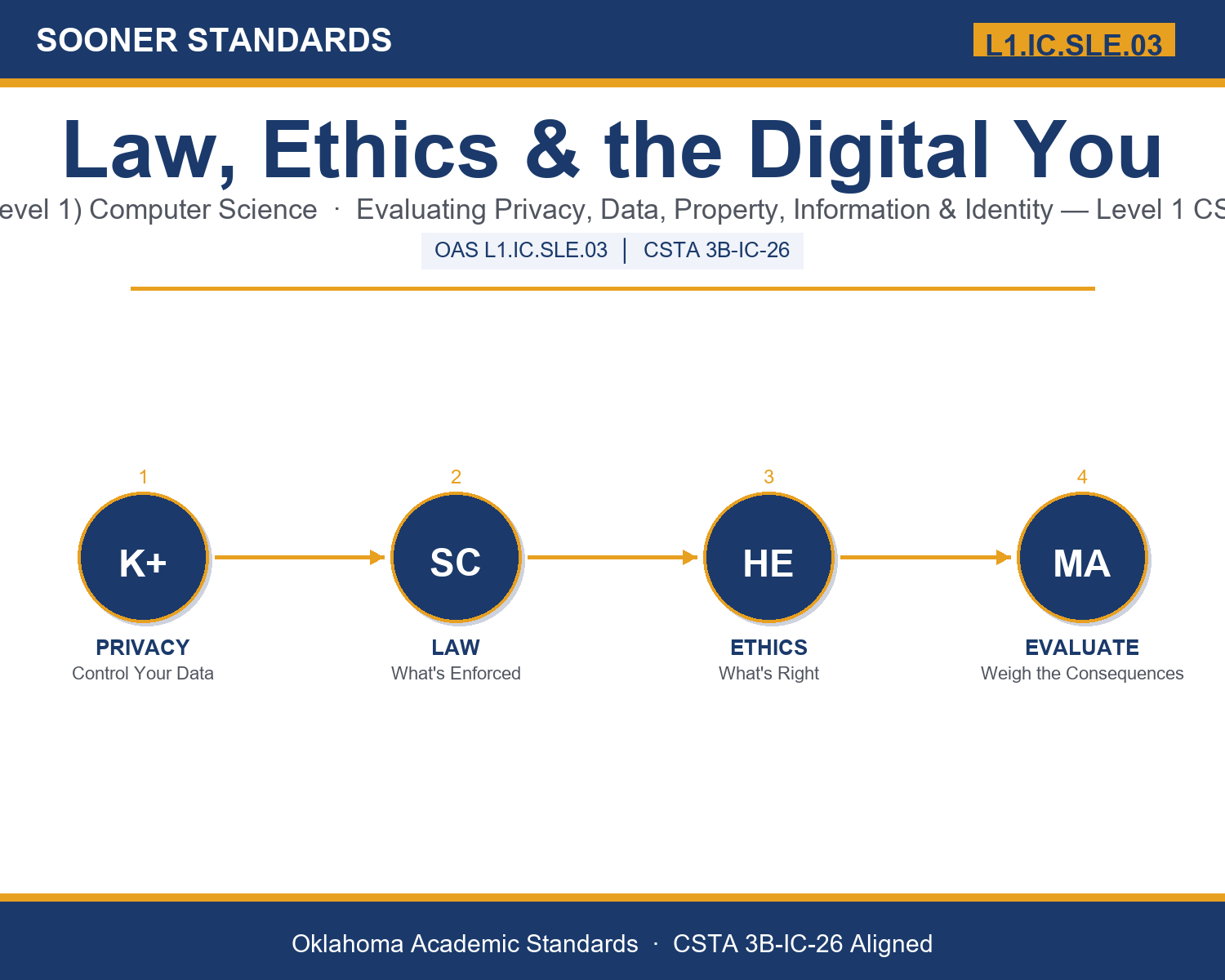
Teaching Law, Ethics & the Digital You in Grades 9-10 (Level 1): Oklahoma Standard L1.IC.SLE.03
Teaching Law, Ethics & the Digital You in Grades 9-10 (Level 1): Oklahoma Standard L1.IC.SLE.03
Teaching digital privacy ethics in grades 9-10 (level 1) does not have to be complicated. Picture a company delaying data-breach notification to protect its stock price. That kind of thinking is exactly what Oklahoma's grades 9-10 (level 1) computer science standard L1.IC.SLE.03 asks students to practice — and it is very teachable with the right materials. This post walks through what the standard means, the misconceptions students bring to it, and discussion starters you can use tomorrow, whether you teach in a classroom or at your kitchen table.
What Does Standard L1.IC.SLE.03 Actually Ask?
Evaluate the social and economic consequences of how law and ethics interact with digital aspects of privacy, data, property, information, and identity. — Oklahoma Academic Standards for Computer Science (February 2023)
In plain language: This standard asks Level 1 students (grades 9-10) to evaluate the social and economic consequences of how law and ethics interact with four digital aspects: privacy, data, property, information, and identity, using real or realistic examples.
In student-friendly terms, the learning target is: "I can evaluate the social and economic consequences of how law and ethics interact with digital privacy, data, property, information, and identity, and explain where a real outcome met, fell short of, or exceeded a reasonable ethical standard."
What Students Should Be Able to Do
- I can explain the difference between a legal question and an ethical question in a digital context.
- I can identify a social consequence and an economic consequence for a real privacy, data, property, information, or identity scenario.
- I can evaluate whether a real digital outcome met, fell short of, or exceeded a reasonable ethical standard, using evidence.
- I can explain why technology often changes faster than the law can keep pace with it.
Along the way, students pick up the working vocabulary of the topic: privacy, ethics, consent, regulation, copyright, breach, encryption, surveillance, licensing, anonymity, identity, legislation, liability, plagiarism.
Digital Privacy Ethics: Misconceptions to Watch For
These are the wrong turns students reliably take with this standard — knowing them ahead of time is half the lesson plan. Each correction strategy below comes straight from the unit's teacher guide (the paragraph and activity references point into the unit itself).
1. "If something is legal, it must also be ethical."
Return to paragraph 1. Law and ethics are related but different systems; something can meet the legal minimum while still causing real harm that many people consider unethical.
2. "Clicking 'I agree' on a privacy policy always means a user fully understood and chose to allow whatever the company does with their data."
Point back to paragraph 2. Clicking 'agree' is technically legal consent, but the length and complexity of most policies raises a real ethical question about whether that consent was genuinely informed.
3. "Companies are always held fully legally responsible for any data breach, regardless of the circumstances."
Revisit paragraph 3's discussion of liability. Whether a company is found liable often depends on whether it took reasonable security precautions before the breach, not simply on the fact that a breach occurred.
4. "Social media platforms are legally required to remove any false information posted by users."
Emphasize the distinction in paragraph 5 between the legal reality (platforms are generally not liable for user posts) and the separate ethical argument that platforms should still act responsibly.
Discussion Starters You Can Use Tomorrow
- Think of an app you use daily. What is one piece of data it likely collects that you had not thought about before this unit?
- Why might a lawmaker take years to pass a regulation addressing a technology practice that is already causing harm right now?
- Describe a situation where anonymity online could protect someone, and a different situation where the same anonymity could allow someone to cause harm without accountability.
Bringing It Home
This topic is a natural one for families. One ten-minute activity to try: Together, pick one app or website your family uses regularly and find its privacy policy or terms of service (usually linked at the very bottom of the app's settings or the website's homepage). Read just the first few sentences together and talk about what data it says the company can collect. There are no wrong answers — the goal is practicing how to read and question a real digital agreement together.
Where This Leads
Students who can evaluate the social and economic consequences of how law and ethics interact with digital privacy, data, property, information, and identity, and explain where a real outcome met, fell short of, or exceeded a reasonable ethical standard are building skills used every day in privacy and compliance, technology policy, cybersecurity, and digital rights law.
See the Unit in Action
Get the Complete L1.IC.SLE.03 Unit
I built a complete, no-prep unit for this standard — Law, Ethics, and the Digital You: Evaluating the Real Cost of Privacy, Data, and Identity — covering 3-4 days of instruction across 44 pages:
- Teacher guide — day-by-day pacing, misconceptions to watch for, discussion questions, differentiation for support / ELL / extension, and a 4-point rubric
- Student learning target page — a kid-friendly "I can" statement with success criteria
- Full content lesson with 3 embedded "Check Your Understanding" checkpoints
- 12-question assessment (6 multiple choice, 4 true/false, 2 short answer) with a complete answer key, explanations, and exemplar responses
- Group activity — "Evaluate the Case: Law, Ethics, and the Digital You" (25-30 minutes)
- Individual activity — "My Digital Privacy Policy Audit" (20 minutes)
- Crossword and word search built from all 14 vocabulary terms (with answer keys)
- Family connection letter — a plain-language page for parents, with dinner-table questions and a 10-minute home activity
- Certificate of achievement — ready to sign and send home
- Case Scenario Card Set: Evaluate the Case (separate printable, 2 pages)
- Reference Sheet: Evaluating a Digital Law-and-Ethics Case (separate printable, 2 pages)
- My Digital Privacy Policy Audit (separate printable, 2 pages)
Get Law, Ethics & the Digital You on Teachers Pay Teachers →
Also aligned to CSTA 3B-IC-26: Evaluate the social and economic implications of privacy in the context of digital government, digital identity, and private industry.
Every Sooner Standards resource is built directly from the official Oklahoma Academic Standards for Computer Science (February 2023) — standard text verified, never paraphrased from memory.