Code Reuse and Attribution: Libraries, Modules, and Giving Credit
Teaching Code Reuse and Attribution in Grade 8: Oklahoma Standard 8.AP.PD.02
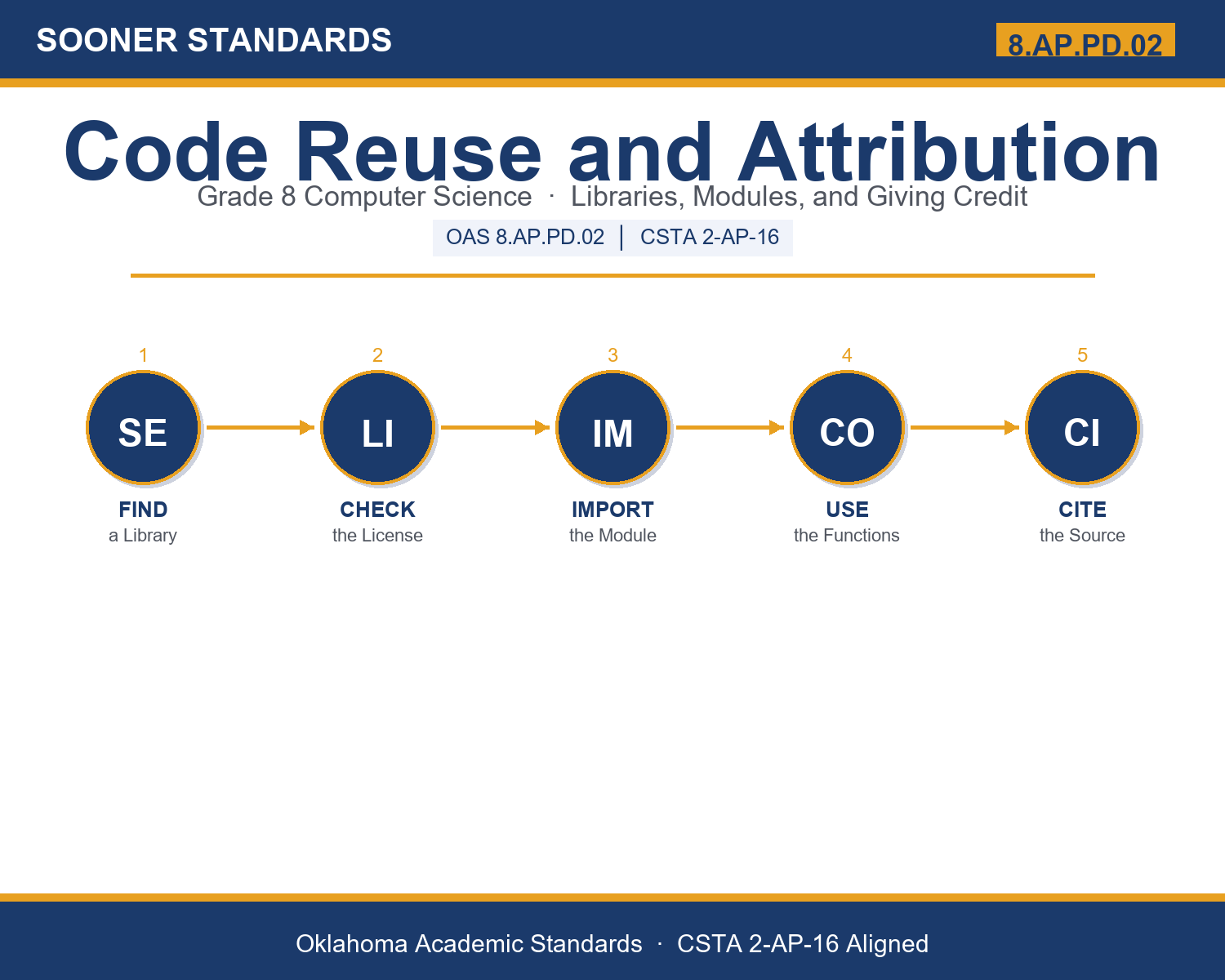
Professional programmers almost never write every line of a program from scratch — they build on code, media, and libraries that other developers have already created. Oklahoma's standard 8.AP.PD.02 asks eighth graders to practice that same skill responsibly: incorporating existing code, media, and libraries into original programs of increasing complexity, and giving proper attribution when they do. This post walks through what the standard means, the vocabulary students need, and a few discussion starters you can use tomorrow.
What Does Standard 8.AP.PD.02 Actually Ask?
Incorporate existing code, media, and libraries into original programs of increasing complexity and give attribution. — Oklahoma Academic Standards for Computer Science (February 2023)
In plain language: students need to know how to responsibly use resources someone else built — importing a library, reusing a snippet, remixing media — while clearly crediting where that resource came from.
Key Vocabulary Students Will Learn
Library, Attribution, License, Import, Module, Reuse, Copyright, Citation, Framework, Remix, Reference, Dependency, Plagiarism
These terms sit at the intersection of two skills students need simultaneously: the technical skill of using someone else's code, and the ethical skill of crediting it honestly.
What's Inside the Lesson
The content reading frames code reuse as one of the most powerful and practical skills a programmer can develop — the ability to effectively incorporate existing code into new programs. Rather than writing every function from scratch, professional programmers regularly use libraries, modules, and frameworks that other developers have already created, tested, and shared. This dramatically accelerates development, because problems that have already been solved well don't need to be solved again.
The reading is careful to pair that efficiency argument with the responsibility that comes with it — using someone else's work well means crediting it properly, every time.
Discussion Starters You Can Use Tomorrow
- If you use a piece of code someone else wrote and shared publicly, what information do you think you should include to credit them?
- Why might reusing a well-tested library actually make your program more reliable than writing that same function yourself?
- What's the difference between reusing code with attribution and copying code without credit?
Where This Leads
Students who can incorporate existing code and media with proper attribution are building a skill that professional developers rely on every single day — and one that matters far beyond computer science, in any field where giving credit for someone else's work is the difference between honest collaboration and plagiarism.
See the Unit in Action
Get the Complete 8.AP.PD.02 Unit
I built a complete, no-prep unit for this standard — Code Reuse and Attribution: Libraries, Modules, and Giving Credit — across 22 ready-to-print pages:
- Vocabulary reference — all 13 terms with definitions and real-world examples
- Full content reading with embedded comprehension checkpoints
- 10-question assessment (6 multiple choice, 4 true/false) with a complete answer key and explanations
- Group activity — "Library Explorer and Attribution Challenge"
- Individual activity — "Attribution Audit"
- Crossword and word search built from all 13 vocabulary terms (with answer keys)
- Standards alignment verification page
- Attribution Worksheet (separate printable)
- Reference Guide (separate printable)
Get Code Reuse and Attribution on Teachers Pay Teachers →
Every Sooner Standards resource is built directly from the official Oklahoma Academic Standards for Computer Science (February 2023) — standard text verified, never paraphrased from memory.