Teaching Our Online Code of Conduct in Grade 5: Oklahoma Standard 5.IC.SI.01
Teaching Our Online Code of Conduct in Grade 5: Oklahoma Standard 5.IC.SI.01
Teaching digital citizenship in grade 5 does not have to be complicated. Picture apps and games enforcing community guidelines with report and block tools. That kind of thinking is exactly what Oklahoma's grade 5 computer science standard 5.IC.SI.01 asks students to practice — and it is very teachable with the right materials. This post walks through what the standard means, the misconceptions students bring to it, and discussion starters you can use tomorrow, whether you teach in a classroom or at your kitchen table.
What Does Standard 5.IC.SI.01 Actually Ask?
Develop a code of conduct, explain, and practice grade-level appropriate behavior and responsibilities while participating in an online community. Identify and report inappropriate behavior. — Oklahoma Academic Standards for Computer Science (February 2023)
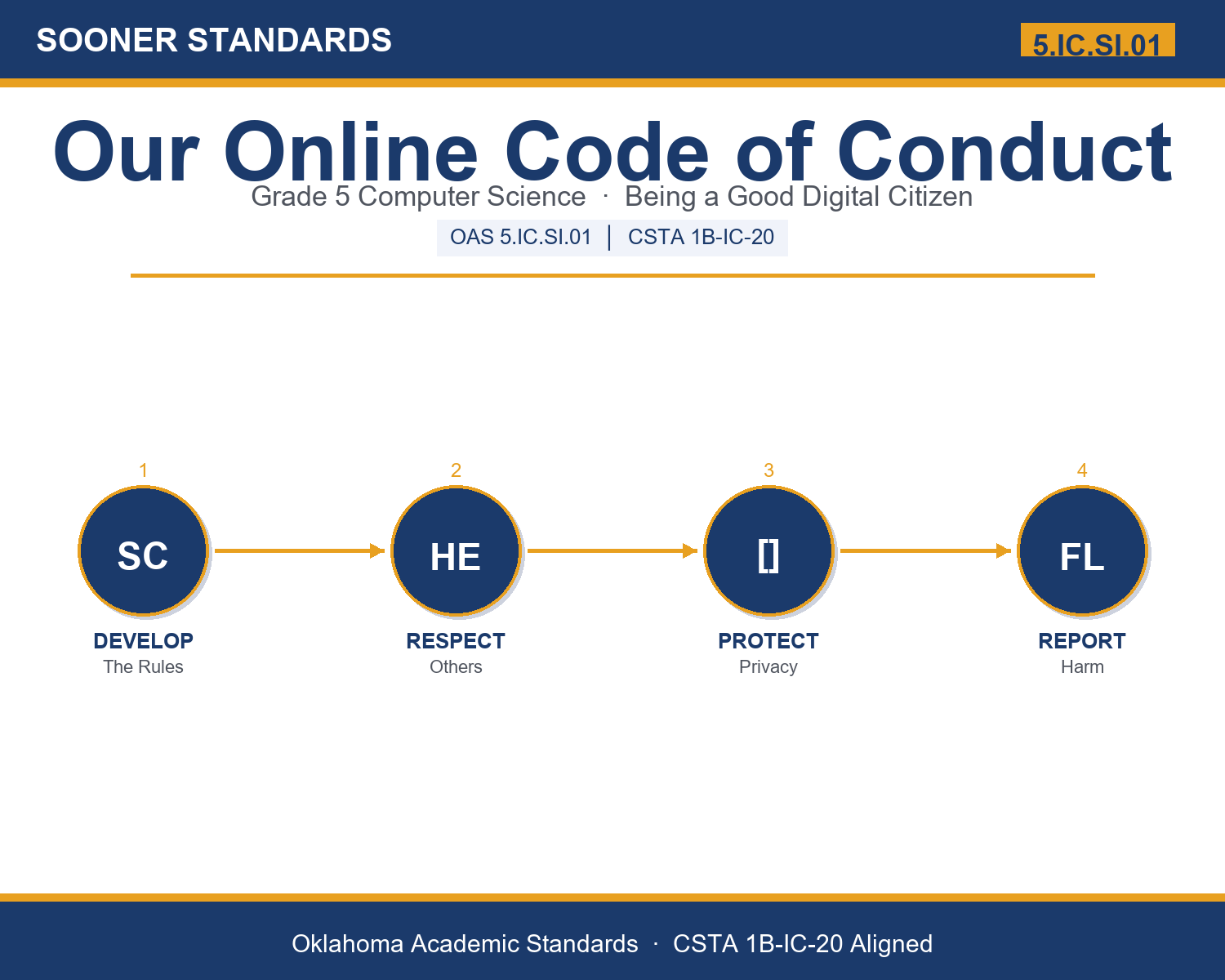
In plain language: Oklahoma's standard asks fifth graders to help build a code of conduct (agreed-upon rules), practice kind and responsible behavior in online spaces, and know how to recognize and report inappropriate behavior to a trusted adult.
In student-friendly terms, the learning target is: "I can help develop a code of conduct, practice respectful and responsible behavior in an online community, and identify and report inappropriate behavior."
What Students Should Be Able to Do
- I can explain what a code of conduct is and write positive rules for one.
- I can describe respectful, responsible behavior and how to protect privacy and safety online.
- I can identify inappropriate behavior like cyberbullying and warning signs.
- I can explain how to report a problem and why reporting is not tattling.
Along the way, students pick up the working vocabulary of the topic: conduct, citizen, digital, actions, community, respect, privacy, caring, honest, report, safety, online.
Digital Citizenship: Misconceptions to Watch For
These are the wrong turns students reliably take with this standard — knowing them ahead of time is half the lesson plan. Each correction strategy below comes straight from the unit's teacher guide (the paragraph and activity references point into the unit itself).
1. "Reporting harmful online behavior is the same as tattling."
Paragraph 6: tattling is over something small to get someone in trouble; reporting keeps someone safe from real harm. Practice sorting examples into 'report' vs. 'handle yourself.'
2. "It is fine to be a little mean online because the other person is not real or cannot be hurt."
Paragraph 3: behind every screen is a real person with real feelings. Reinforce treating others online as you would in person, or better.
3. "Codes of conduct only list what you cannot do."
Paragraph 2: strong codes are positive, telling members what TO do ('treat everyone with respect'), which is clearer and more effective than only listing bans.
4. "If you are cyberbullied, you should handle it yourself or get revenge."
Paragraphs 6-7: it is never your fault, and the right move is to stay calm, save evidence, and tell a trusted adult, not to retaliate alone.
Discussion Starters You Can Use Tomorrow
- What is one rule you think every online community should have, and why?
- Why can it be harder to be kind online than in person?
- What is the difference between disagreeing with someone's idea and attacking the person?
Bringing It Home
This topic is a natural one for families. One ten-minute activity to try: Together, write a short family 'online code of conduct' with three or four rules everyone agrees to, such as being kind, protecting privacy, and telling a trusted adult about anything scary. Talk about the stop, do-not-respond, save, and tell plan, and name the trusted adults your child can always come to. Post your family rules somewhere everyone can see them.
Where This Leads
Students who can help develop a code of conduct, practice respectful and responsible behavior in an online community, and identify and report inappropriate behavior are building skills used every day in online safety and trust, community management, counseling, law and ethics, and education.
Part of the Complete Grade 5 Computer Science Curriculum
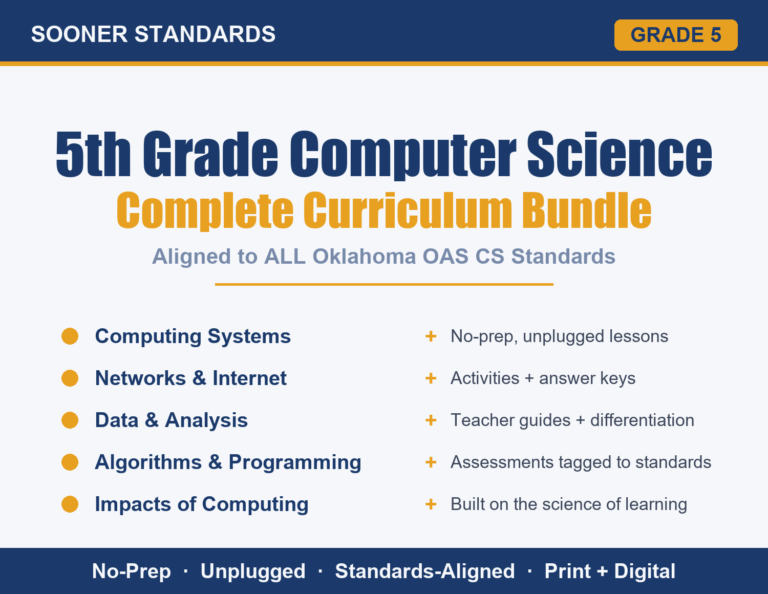
This lesson covers just one standard. It is part of a complete grade 5 computer science curriculum aligned to every Oklahoma OAS CS standard. See the full listing — every standard, organized by strand — here: Grade 5 Computer Science Curriculum: Every Oklahoma OAS CS Standard.
See the Unit in Action
Get the Complete 5.IC.SI.01 Unit
I built a complete, no-prep unit for this standard — Our Online Code of Conduct: Being a Good Digital Citizen — covering 3-4 days of instruction across 40 pages:
- Teacher guide — day-by-day pacing, misconceptions to watch for, discussion questions, differentiation for support / ELL / extension, and a 4-point rubric
- Student learning target page — a kid-friendly "I can" statement with success criteria
- Full content lesson with 3 embedded "Check Your Understanding" checkpoints
- 12-question assessment (6 multiple choice, 4 true/false, 2 short answer) with a complete answer key, explanations, and exemplar responses
- Group activity — "Build Our Code of Conduct" (25-30 minutes)
- Individual activity — "My Digital Citizen Pledge" (15-20 minutes)
- Crossword and word search built from all 12 vocabulary terms (with answer keys)
- Family connection letter — a plain-language page for parents, with dinner-table questions and a 10-minute home activity
- Certificate of achievement — ready to sign and send home
- Online Scenario Cards (separate printable, 1 page)
- Digital Citizenship Reference Sheet (separate printable, 2 pages)
- My Digital Citizen Pledge (separate printable, 1 page)
Get Our Online Code of Conduct on Teachers Pay Teachers →
Also aligned to CSTA 1B-IC-20: Develop and practice a code of conduct and identify and report inappropriate behavior in online communities.
Every Sooner Standards resource is built directly from the official Oklahoma Academic Standards for Computer Science (February 2023) — standard text verified, never paraphrased from memory.