
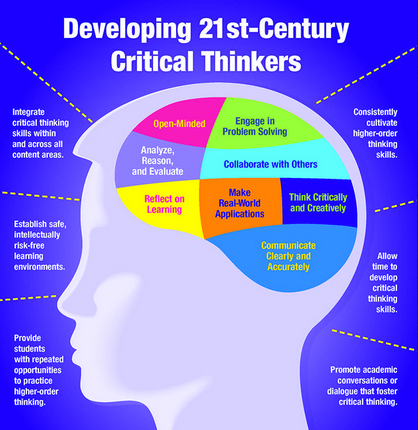
What is Critical Thinking
I have commented before, our youth has lost their ability to critically think. However, what exactly is critical thinking? Have we, as the generation before, failed our youth in teaching the art of critical thinking?

What is Critical Thinking?
Critical thinking can be seen as having two components:
1) a set of information and belief generating and processing skills, and
2) the habit, based on intellectual commitment, of using those skills to guide behavior. [Source]
This two-fold definition can also be summarized as acquiring information, and applying action based on the provided information. In order to apply the valuable actions, the information must be solid or true.
Additionally, critical thinking is to make logical judgments that are well-thought out and are made after analysing the facts carefully. [Source]
Yet, today we can see all our information is filtered through bias, a desired narrative, or missing all together.
More importantly, the true information or facts are hard to reach today and many lost the skills to acquire solid information.

Methods or Steps in Critical Thinking
We need to identify some of the methods to critical thinking, and understand how to apply them.
There are commonly five steps in critical thinking.
1. Identify a Question
2. Gather Data, Research Multiple Sources
3. Analyze the Data
4. Make a Decision/ Conclusion
5. Publish or Present
While these steps seem obvious and simple, many of us skip steps 2 and 3. Additionally, many of us allow others give us step 1, without thinking about it.
Step One – Identify a Question
Without realizing it, step one is crucial. How we frame or construct our question will determine our research. In the scientific method, one must make an observation first, then ask the question.
How we observe, identifing the observation will help us ask the critical questions. If we allow someone else to frame that question, control is already in place to steer the narrative.
Step two – Gather Data, Research Multiple Sources
Gather data from multiple sources is becoming harder today. Yes, we have the advantage of the Internet, extrapolating data from multiple websites. However, when we consider six corporations own all of United States media, we can see the control. [Source]
Therefore we need to reach outside the confines of the easy access, and this takes time. Attempt to pull in statistical data, printed data, as well as your online data.
Step three – Analyze the Data
Now we have gathered our resources, we need to review our data.
As you review your data, you may find you have the exact data you need, but more likely, you might need to revise your original question or collect more data.
Step four – Make a Decision/ Conclusion
I came across an interesting article conveying conclusions are not decisions. They go on to say, ” Only one right conclusion exists and we must draw it from the data by using logical reasoning and technical knowledge” and “a conclusion can be ‘right’ or ‘wrong’, (2+2=5), but not ‘Good’ or ‘Bad’. A decision can be ‘Good’ or ‘Bad’, but not ‘right’ or ‘wrong ” [Source]
The point is, we need proper analysis of our data to make a sound conclusion. Then based on that conclusion, we attempt to make a good decision or view.

Matt Cole has high regard for knowledge share. He has a desire to share critical thinking and information. With a Masters in Information Technology and a wide array of certifications, while not working full-time, he wishes to knowledge share through providing insight, information organization, and critical thinking skills.
#KnowledgeShare | Matt Cole | #infobyMattCole