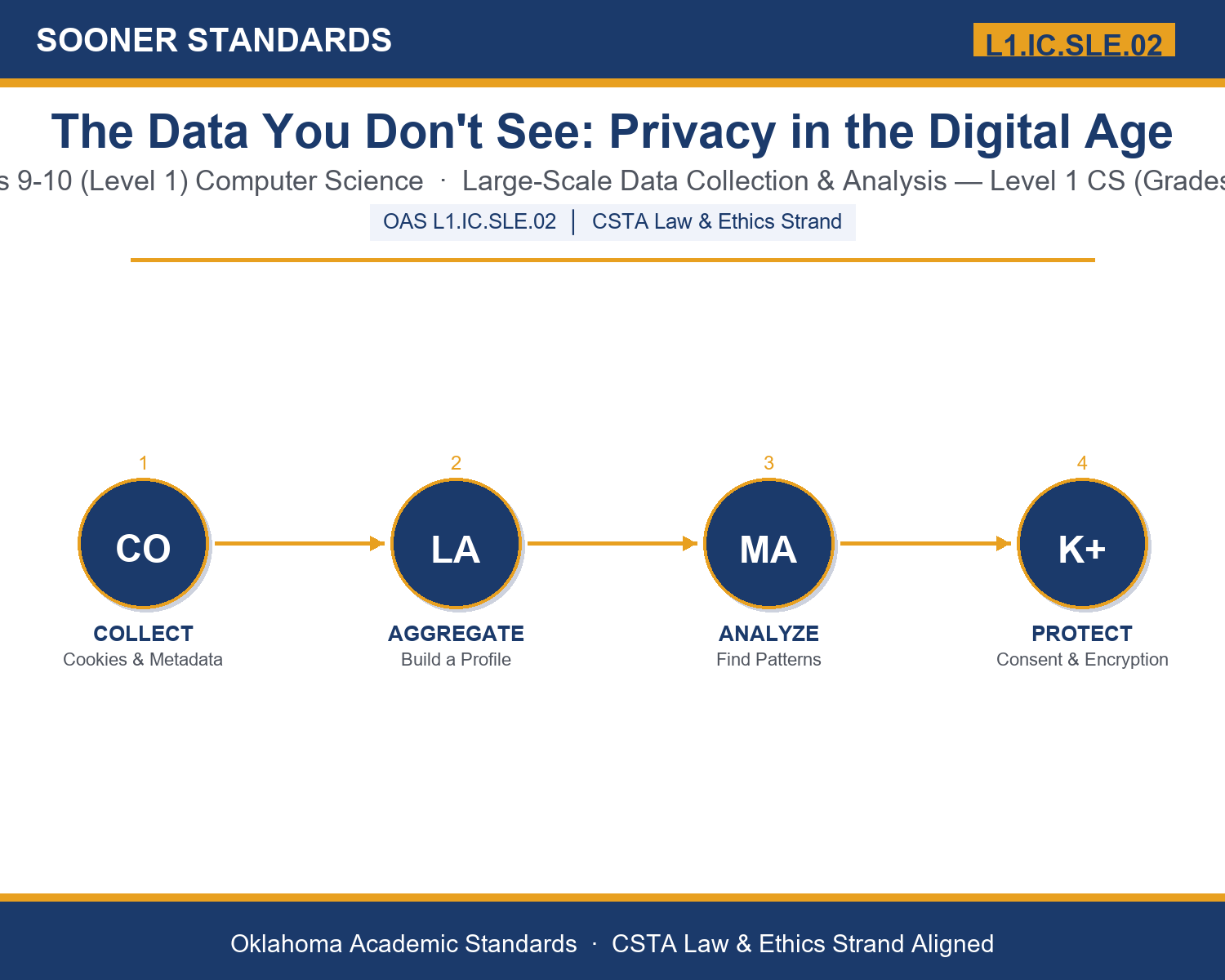
Teaching The Data You Don’t See: Privacy in the Digital Age in Grades 9-10 (Level 1): Oklahoma Standard L1.IC.SLE.02
Teaching The Data You Don't See: Privacy in the Digital Age in Grades 9-10 (Level 1): Oklahoma Standard L1.IC.SLE.02
Teaching data privacy high school in grades 9-10 (level 1) does not have to be complicated. Picture a shopping website combining browsing history, purchases, and location into a single advertising profile. That kind of thinking is exactly what Oklahoma's grades 9-10 (level 1) computer science standard L1.IC.SLE.02 asks students to practice — and it is very teachable with the right materials. This post walks through what the standard means, the misconceptions students bring to it, and discussion starters you can use tomorrow, whether you teach in a classroom or at your kitchen table.
What Does Standard L1.IC.SLE.02 Actually Ask?
Describe and discuss the privacy concerns related to the large-scale collection and analysis of information about individuals (e.g., how websites collect and uses data) that may not be evident to users. — Oklahoma Academic Standards for Computer Science (February 2023)
In plain language: This standard asks Level 1 students (grades 9-10) to describe and discuss the privacy concerns connected to how companies collect and analyze large amounts of information about individuals, including collection and analysis practices that most users never notice happening.
In student-friendly terms, the learning target is: "I can describe and discuss the privacy concerns related to the large-scale collection and analysis of information about individuals, including practices that are not evident to users."
What Students Should Be Able to Do
- I can name and describe at least three specific methods of large-scale data collection, such as cookies, app permissions, and metadata.
- I can explain how aggregation and algorithmic analysis can reveal more about a person than any single piece of data alone.
- I can evaluate whether a specific consent process is genuinely informed or undermined by dense language or manipulative design.
- I can describe real-world consequences of invisible data collection, including who is affected and how.
Along the way, students pick up the working vocabulary of the topic: privacy, tracking, cookie, metadata, consent, profile, aggregation, anonymization, encryption, surveillance, breach, algorithm, dataset.
Data Privacy High School: Misconceptions to Watch For
These are the wrong turns students reliably take with this standard — knowing them ahead of time is half the lesson plan. Each correction strategy below comes straight from the unit's teacher guide (the paragraph and activity references point into the unit itself).
1. "If a company collects data legally and discloses it somewhere, there is no privacy concern."
Return to paragraph 4. Even legally collected, disclosed data can be analyzed in ways that reveal sensitive patterns a person never intended to share — the privacy concern can live in the analysis stage, not just the collection stage.
2. "A single piece of data, like one search or one location ping, is not really a privacy risk."
Point back to paragraph 3's aggregation discussion. Individual data points rarely feel alarming, but combined through aggregation they can build a profile far more revealing than any single piece alone.
3. "Clicking 'I Agree' on a privacy policy always means a user has given informed consent."
Revisit paragraph 5. Technical consent and informed consent are not the same thing — dense legal language and dark patterns routinely undermine genuine understanding of what was agreed to.
4. "Data privacy concerns affect everyone equally, so there is no reason to think about specific vulnerable groups."
Emphasize paragraph 6's discussion of domestic violence survivors and marginalized communities. Some groups face measurably higher risk and more serious consequences from the same data practices that affect everyone.
Discussion Starters You Can Use Tomorrow
- Think of a time an ad or recommendation seemed to 'know' something about you. Which collection method from the reading (cookies, permissions, metadata, aggregation) do you think was most likely responsible?
- Why might a company prefer to bury an opt-out option in small text rather than making it as easy to find as the 'Accept All' button?
- Describe a situation where data collected for one legitimate purpose could be analyzed in a way that crosses an ethical line, even without breaking any law.
Bringing It Home
This topic is a natural one for families. One ten-minute activity to try: Together, pick one app on a family member's phone and open its permissions or privacy settings. Ask your student to explain, in plain language, what data the app can access and why it might request each item. Talk together about whether any of the permissions surprised you and whether you'd consider changing any settings. There are no wrong answers — the goal is hearing their reasoning.
Where This Leads
Students who can describe and discuss the privacy concerns related to the large-scale collection and analysis of information about individuals, including practices that are not evident to users are building skills used every day in privacy engineering, data analysis, cybersecurity, and technology policy.
See the Unit in Action
Get the Complete L1.IC.SLE.02 Unit
I built a complete, no-prep unit for this standard — The Data You Don't See: Privacy in an Age of Large-Scale Collection — covering 3-4 days of instruction across 43 pages:
- Teacher guide — day-by-day pacing, misconceptions to watch for, discussion questions, differentiation for support / ELL / extension, and a 4-point rubric
- Student learning target page — a kid-friendly "I can" statement with success criteria
- Full content lesson with 3 embedded "Check Your Understanding" checkpoints
- 12-question assessment (6 multiple choice, 4 true/false, 2 short answer) with a complete answer key, explanations, and exemplar responses
- Group activity — "Decode the Fine Print: Privacy Policy Investigation" (25-30 minutes)
- Individual activity — "My Data Trail Log" (20 minutes)
- Crossword and word search built from all 13 vocabulary terms (with answer keys)
- Family connection letter — a plain-language page for parents, with dinner-table questions and a 10-minute home activity
- Certificate of achievement — ready to sign and send home
- Privacy Policy Excerpt Set (separate printable, 2 pages)
- Reference Sheet: Privacy Concern Analysis (separate printable, 1 page)
- My Data Trail Log (separate printable, 2 pages)
Get The Data You Don't See: Privacy in the Digital Age on Teachers Pay Teachers →
Also aligned to CSTA Law & Ethics Strand: Explain the beneficial and harmful effects that intellectual property laws can have on innovation.
Every Sooner Standards resource is built directly from the official Oklahoma Academic Standards for Computer Science (February 2023) — standard text verified, never paraphrased from memory.