Teaching Team Coding in Action: Build an Event-Based Program in Grades 9-10 (Level 1): Oklahoma Standard L1.AP.PD.03
Teaching Team Coding in Action: Build an Event-Based Program in Grades 9-10 (Level 1): Oklahoma Standard L1.AP.PD.03
Teaching event based programming team in grades 9-10 (level 1) does not have to be complicated. Picture a game development team building and testing player-input handlers for collisions and scoring. That kind of thinking is exactly what Oklahoma's grades 9-10 (level 1) computer science standard L1.AP.PD.03 asks students to practice — and it is very teachable with the right materials. This post walks through what the standard means, the misconceptions students bring to it, and discussion starters you can use tomorrow, whether you teach in a classroom or at your kitchen table.
What Does Standard L1.AP.PD.03 Actually Ask?
While working in a team, develop, test, and refine event- based programs that solve practical problems or allow self-expression. — Oklahoma Academic Standards for Computer Science (February 2023)
In plain language: This standard asks Level 1 students (grades 9-10) to work in a team to develop, test, and refine a program that reacts to events like clicks or key presses, and to explain how the process applies whether the program solves a practical problem or is built purely for self-expression.
In student-friendly terms, the learning target is: "I can describe how to develop, test, and refine an event-based program while working in a team, and explain how the process applies to programs that solve practical problems or allow self-expression."
What Students Should Be Able to Do
- I can explain what an event, a trigger, and a handler are, and describe how they work together.
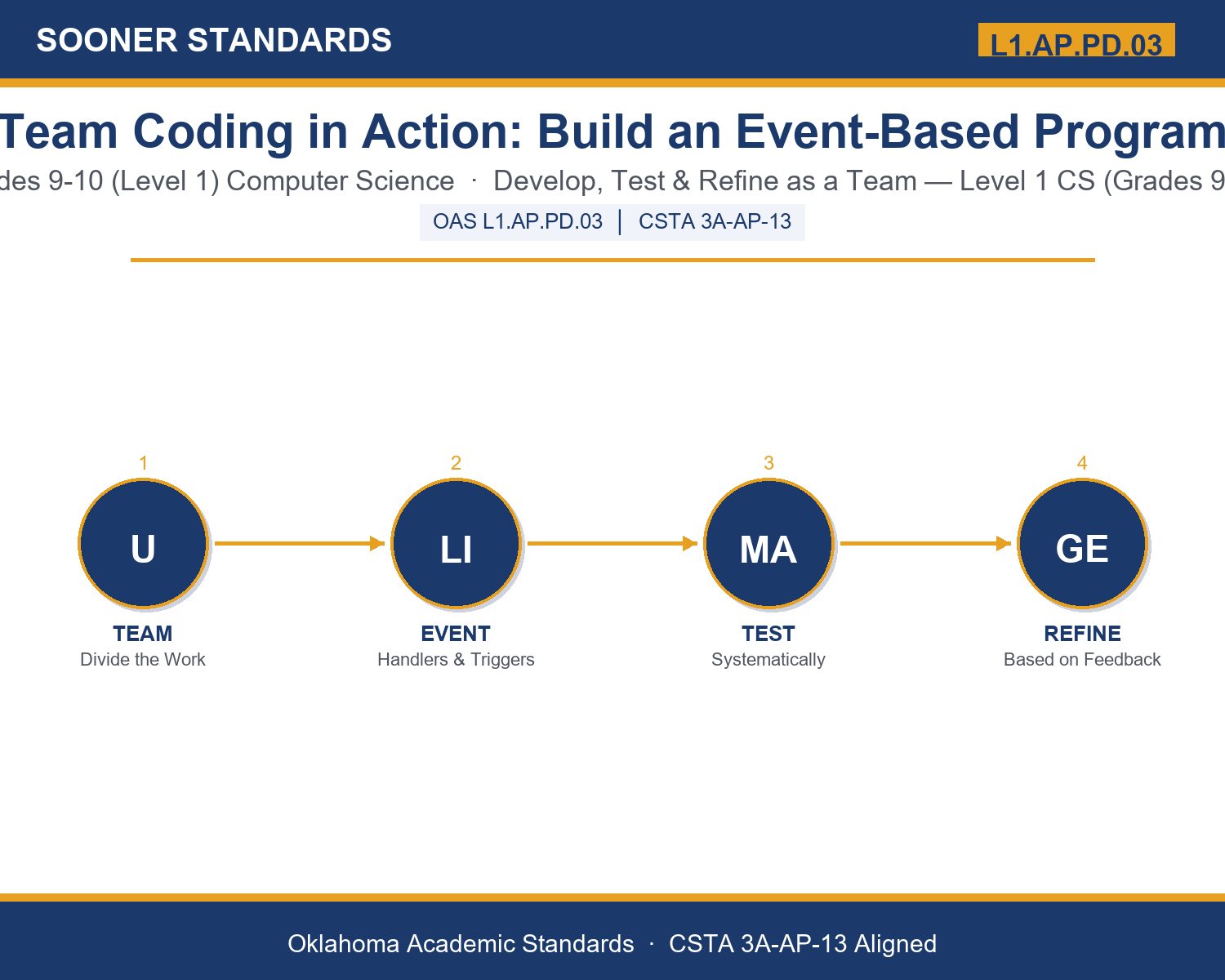
- I can describe how a team should divide work when building an event-based program.
- I can write a systematic testing plan that includes more than one input or event sequence.
- I can describe a specific, targeted refinement based on test results or feedback.
Along the way, students pick up the working vocabulary of the topic: event, handler, trigger, listener, teamwork, testing, refine, debug, feedback, interface, function, collaboration.
Event Based Programming Team: Misconceptions to Watch For
These are the wrong turns students reliably take with this standard — knowing them ahead of time is half the lesson plan. Each correction strategy below comes straight from the unit's teacher guide (the paragraph and activity references point into the unit itself).
1. "An event-based program runs the same fixed sequence of steps every single time, like a recipe read start to finish."
Return to paragraph 2. Event-based programs are reactive — they respond to events in whatever order those events actually happen, which is why the same program can behave differently depending on what the user does first.
2. "If each teammate's handler works correctly on its own, the combined program will automatically work too."
Point back to paragraph 2 and paragraph 4. Handlers that touch the same shared variable, or that were built on different unstated assumptions, can conflict even when each one works fine in isolation. That's why the team must test the combined program together.
3. "Testing means running the program once and checking whether it looks correct."
Revisit paragraph 4's description of systematic testing. Testing means deliberately trying a range of inputs and event sequences, including unusual ones like double-clicking a button, not just the single most obvious path.
4. "Programs built for self-expression, like interactive art, don't really need to be tested and refined the way a 'real' program does."
Emphasize paragraph 7: self-expression programs follow the exact same development, testing, and refining process as practical-problem programs. A self-expression program that crashes still fails the standard.
Discussion Starters You Can Use Tomorrow
- Think of an app you use daily. Name three separate events it responds to, and describe what handler you think runs for each one.
- Why might a team decide to test their combined program together even after every teammate has already tested their own handler individually?
- Describe a real-world situation, outside of coding, where two people's work looked fine separately but caused a problem once combined. What does that have in common with integrating event handlers on a team?
Bringing It Home
This topic is a natural one for families. One ten-minute activity to try: Together, pick an app or device your family uses that clearly reacts to something you do — a doorbell camera, a smart speaker, a game controller. Ask your student to list at least three different things it reacts to (events) and what it does in response (handlers). Talk about what might go wrong if two of those reactions happened at almost the same time. There are no wrong answers — the goal is hearing their reasoning.
Where This Leads
Students who can describe how to develop, test, and refine an event-based program while working in a team, and explain how the process applies to programs that solve practical problems or allow self-expression are building skills used every day in game development, front-end web development, quality assurance / software testing, and mobile app development.
See the Unit in Action
Get the Complete L1.AP.PD.03 Unit
I built a complete, no-prep unit for this standard — Team Coding in Action: Develop, Test, and Refine Event-Based Programs — covering 3-4 days of instruction across 43 pages:
- Teacher guide — day-by-day pacing, misconceptions to watch for, discussion questions, differentiation for support / ELL / extension, and a 4-point rubric
- Student learning target page — a kid-friendly "I can" statement with success criteria
- Full content lesson with 3 embedded "Check Your Understanding" checkpoints
- 12-question assessment (6 multiple choice, 4 true/false, 2 short answer) with a complete answer key, explanations, and exemplar responses
- Group activity — "Build It Together: The Event-Handler Team Challenge" (25-30 minutes)
- Individual activity — "My Event-Based Program Design Log" (20 minutes)
- Crossword and word search built from all 12 vocabulary terms (with answer keys)
- Family connection letter — a plain-language page for parents, with dinner-table questions and a 10-minute home activity
- Certificate of achievement — ready to sign and send home
- Event-Handler Planning Card Set (separate printable, 2 pages)
- Reference Sheet: Testing and Refining a Team Program (separate printable, 2 pages)
- My Event-Based Program Design Log (separate printable, 2 pages)
Get Team Coding in Action: Build an Event-Based Program on Teachers Pay Teachers →
Also aligned to CSTA 3A-AP-13: Design and develop a software solution to solve a problem (e.g., prototype, iterate, test, evaluate) using an iterative development process.
Every Sooner Standards resource is built directly from the official Oklahoma Academic Standards for Computer Science (February 2023) — standard text verified, never paraphrased from memory.