Collaboration in Development: Teamwork, Communication, and Computational Artifacts
Teaching Collaboration in Development in Grade 8: Oklahoma Standard 8.AP.PD.04
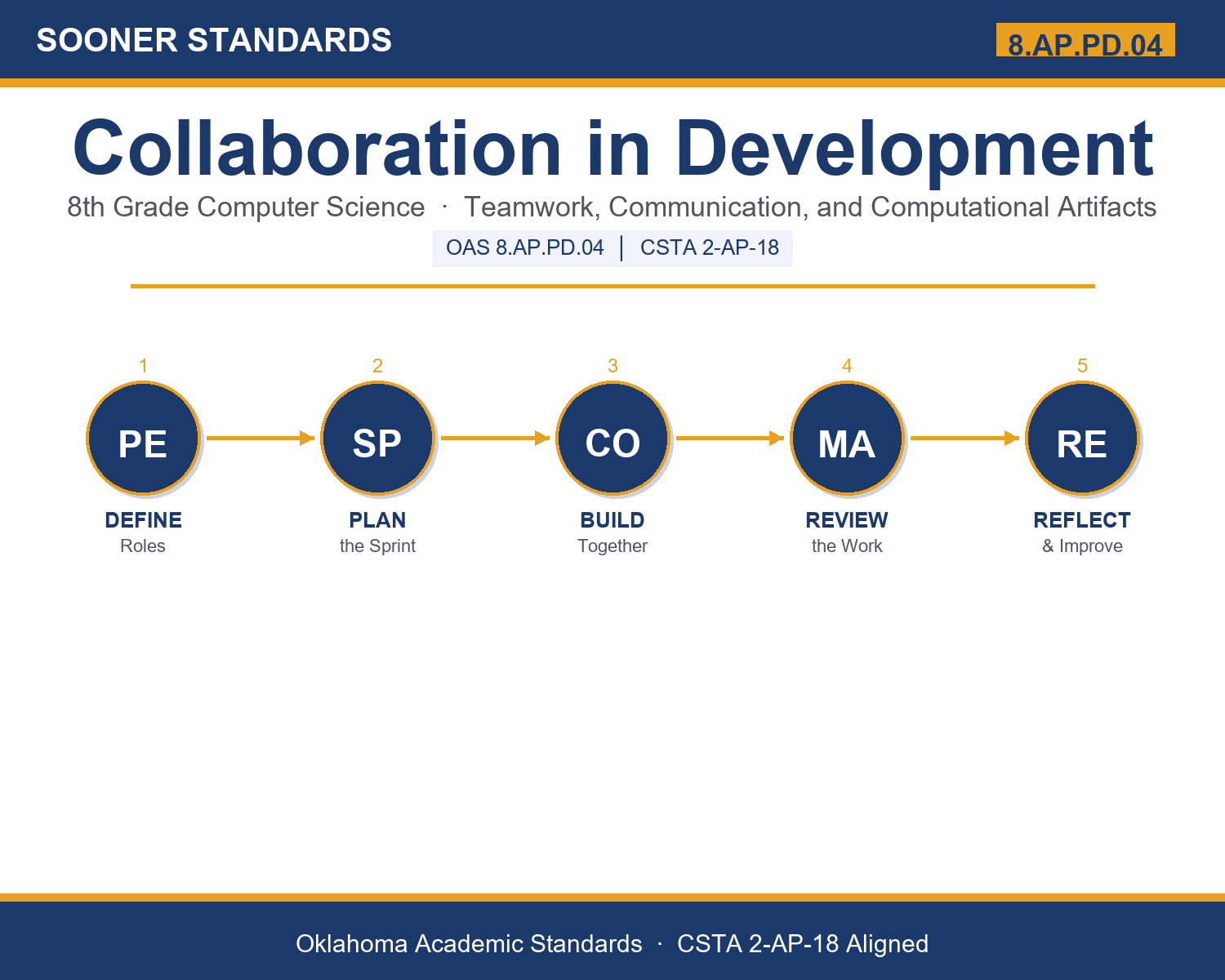
Nearly every app, program, and digital system in the real world is built by a team, not a lone programmer. Oklahoma's standard 8.AP.PD.04 asks eighth graders to practice the communication and collaboration skills that make that teamwork actually work — modeling effective communication between participants and demonstrating successful collaboration when developing computational artifacts. This post walks through what the standard means, the vocabulary students need, and a few discussion starters you can use tomorrow.
What Does Standard 8.AP.PD.04 Actually Ask?
Model effective communication between participants and demonstrate successful collaboration when developing computational artifacts. — Oklahoma Academic Standards for Computer Science (February 2023)
In plain language: students need to practice the "soft" skills of software development directly — dividing responsibilities, communicating clearly, and coordinating progress as a team, not just writing code alone.
Key Vocabulary Students Will Learn
Collaboration, Communication, Workflow, Milestone, Agile, Sprint, Iteration, Repository, Timeline, Review, Scrum, Participant, Artifact
Several of these terms — Agile, Sprint, Scrum — come straight from how real software teams organize their work, giving students a genuine preview of professional development practice.
What's Inside the Lesson
The content reading opens with a direct claim: software development is almost never a solo activity. Learning to collaborate effectively — combining individual skills, dividing responsibilities, and coordinating progress — is framed as just as important as learning to write code. The reading is explicit that collaboration means more than working in the same room; it requires clear communication, defined roles, shared goals, and a workflow that ensures everyone's contribution actually counts.
Discussion Starters You Can Use Tomorrow
- What's one thing that can go wrong on a team project when communication breaks down, even if everyone is trying hard individually?
- Why might a team divide a project into short "sprints" instead of just working toward one big deadline?
- If you and a partner were both editing the same part of a project at the same time, what problems could that cause?
Where This Leads
Students who can communicate clearly and collaborate successfully on a shared project are building a skill that matters in every computing career and far beyond it — the ability to work as part of a team toward something bigger than any one person could build alone.
See the Unit in Action
Get the Complete 8.AP.PD.04 Unit
I built a complete, no-prep unit for this standard — Collaboration in Development: Teamwork, Communication, and Computational Artifacts — across 22 ready-to-print pages:
- Vocabulary reference — all 13 terms with definitions and real-world examples
- Full content reading with embedded comprehension checkpoints
- 10-question assessment (6 multiple choice, 4 true/false) with a complete answer key and explanations
- Group activity — "Sprint Simulation"
- Individual activity — "Collaboration Breakdown Analysis"
- Crossword and word search built from all 13 vocabulary terms (with answer keys)
- Standards alignment verification page
- Collaboration Reference Sheet (separate printable)
- Collaboration Worksheet (separate printable)
Get Collaboration in Development on Teachers Pay Teachers →
Every Sooner Standards resource is built directly from the official Oklahoma Academic Standards for Computer Science (February 2023) — standard text verified, never paraphrased from memory.