Teaching Remix and Modify Programs in Grade 5: Oklahoma Standard 5.AP.M.02
Teaching Remix and Modify Programs in Grade 5: Oklahoma Standard 5.AP.M.02
Teaching modifying code in grade 5 does not have to be complicated. Picture a game studio remixing an existing engine instead of building movement and graphics code from scratch. That kind of thinking is exactly what Oklahoma's grade 5 computer science standard 5.AP.M.02 asks students to practice — and it is very teachable with the right materials. This post walks through what the standard means, the misconceptions students bring to it, and discussion starters you can use tomorrow, whether you teach in a classroom or at your kitchen table.
What Does Standard 5.AP.M.02 Actually Ask?
With grade appropriate complexity, modify, remix, or incorporate portions of an existing program into one's own work, to develop something new or add more advanced features. — Oklahoma Academic Standards for Computer Science (February 2023)
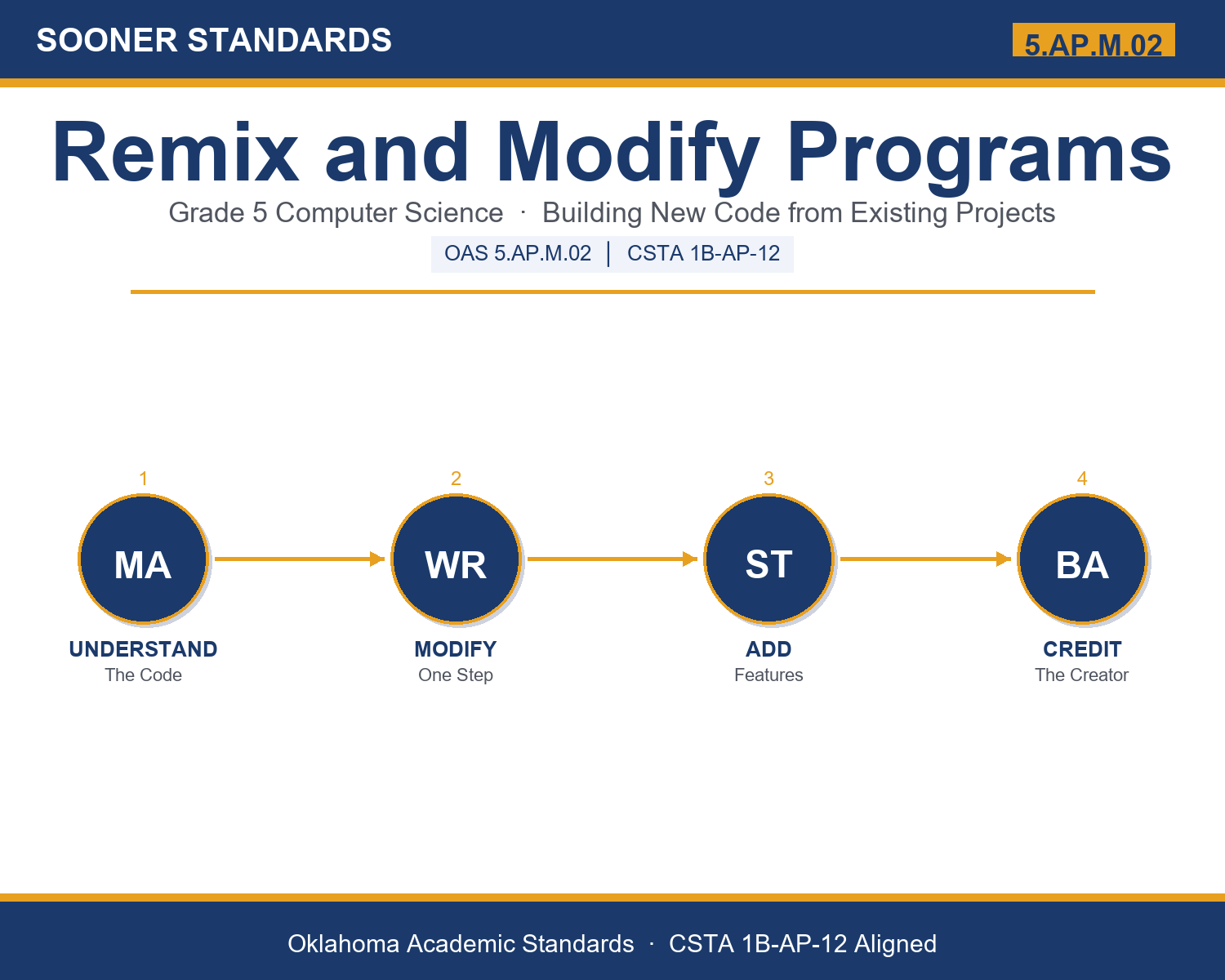
In plain language: Oklahoma's standard asks fifth graders to take an existing program, change part of it, borrow useful pieces, and add new features to make something of their own, while always giving credit to the original creator.
In student-friendly terms, the learning target is: "I can modify, remix, or borrow portions of an existing program to develop something new or add more advanced features, and I can give credit to the original creator."
What Students Should Be Able to Do
- I can read the scripts in an existing program and explain what each one does before I change it.
- I can modify a variable or script and test my change one step at a time.
- I can add a new feature that makes a program do something the original could not.
- I can explain why and how to give credit when I remix or borrow someone's work.
Along the way, students pick up the working vocabulary of the topic: iterate, modify, credit, adapt, feature, script, sprite, variable, remix, debug, program, algorithm.
Modifying Code: Misconceptions to Watch For
These are the wrong turns students reliably take with this standard — knowing them ahead of time is half the lesson plan. Each correction strategy below comes straight from the unit's teacher guide (the paragraph and activity references point into the unit itself).
1. "A good remix is just a copy of someone else's project with one tiny change."
Return to paragraph 4: the standard's key word is new. Have students name three changes that take a project somewhere it had never been (new sprites, new features, new purpose) so the remix clearly becomes their own work.
2. "Reusing or borrowing someone else's code is cheating."
Paragraphs 5 and 8 show professionals reuse code constantly through libraries and engines. Reuse is a core programming skill, not cheating, as long as you give credit. Cheating is claiming someone's work as your own without credit.
3. "You should change lots of blocks at once to finish a remix faster."
Paragraph 3 teaches the modify-test-debug loop. Change one thing, test it, then continue. If you change many things at once and it breaks, you cannot tell which change caused the bug.
4. "Giving credit is just an optional rule that does not really matter."
Paragraph 6 frames credit as honesty and respect that keep a sharing community alive. Ask students how they would feel if a classmate claimed their project, then connect it to professional licenses.
Discussion Starters You Can Use Tomorrow
- Think of a game or app you love. What is one feature you would add to make it better, and what would you need to understand first?
- Why is starting from an existing program sometimes smarter than starting from a blank screen? When might starting from scratch be better?
- What is the difference between a fair remix that gives credit and copying that steals someone's work?
Bringing It Home
This topic is a natural one for families. One ten-minute activity to try: Together, think of something at home that started as someone else's idea and was improved: a favorite recipe with a family twist, a redecorated room, or a customized bike. Ask your child to explain how 'remixing' that thing is like remixing a computer program, and what new feature they added. The goal is hearing how they connect the idea to everyday life.
Where This Leads
Students who can modify, remix, or borrow portions of an existing program to develop something new or add more advanced features, and give credit to the original creator are building skills used every day in software development, game design, web development, app development, and data science.
Part of the Complete Grade 5 Computer Science Curriculum
This lesson covers just one standard. It is part of a complete grade 5 computer science curriculum aligned to every Oklahoma OAS CS standard. See the full listing — every standard, organized by strand — here: Grade 5 Computer Science Curriculum: Every Oklahoma OAS CS Standard.
See the Unit in Action
Get the Complete 5.AP.M.02 Unit
I built a complete, no-prep unit for this standard — Remix and Modify: Building New Programs from Old Ones — covering 3-4 days of instruction across 40 pages:
- Teacher guide — day-by-day pacing, misconceptions to watch for, discussion questions, differentiation for support / ELL / extension, and a 4-point rubric
- Student learning target page — a kid-friendly "I can" statement with success criteria
- Full content lesson with 3 embedded "Check Your Understanding" checkpoints
- 12-question assessment (6 multiple choice, 4 true/false, 2 short answer) with a complete answer key, explanations, and exemplar responses
- Group activity — "Remix Plan: Make It Yours" (25-30 minutes)
- Individual activity — "My Remix Blueprint" (15-20 minutes)
- Crossword and word search built from all 12 vocabulary terms (with answer keys)
- Family connection letter — a plain-language page for parents, with dinner-table questions and a 10-minute home activity
- Certificate of achievement — ready to sign and send home
- Remix Planning Cards (separate printable, 2 pages)
- Programmer's Reference Sheet: Remixing and Modifying (separate printable, 2 pages)
- My Remix Blueprint (separate printable, 1 page)
Get Remix and Modify Programs on Teachers Pay Teachers →
Also aligned to CSTA 1B-AP-12: Modify, remix, or incorporate portions of an existing program into one's own work, to develop something new or add more advanced features.
Every Sooner Standards resource is built directly from the official Oklahoma Academic Standards for Computer Science (February 2023) — standard text verified, never paraphrased from memory.