
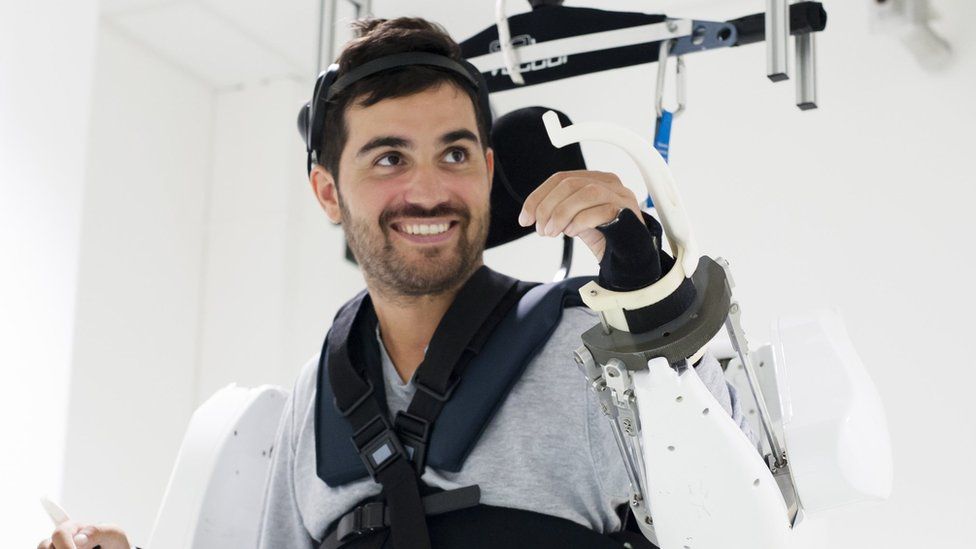
Paralyzed Man Uses Exoskelton with his Brain
French researchers reported their findings in ‘The Lancet’ Neurology Journal. According to the writing, the wireless brain-machine interface provided a proof-of-concept. The demonstration had a tetraplegic (quadriplegic or partial/total loss of all four limbs) patient was able to walk for the first time in two years.
The patient known only as Thiabault, took part in a trial with Clinatec and University of Grenoble. The trial gave him brain implants, allowing him to first control a virtual avatar within a computer. This then moved up to the ability to control the suit, via using only his brain.
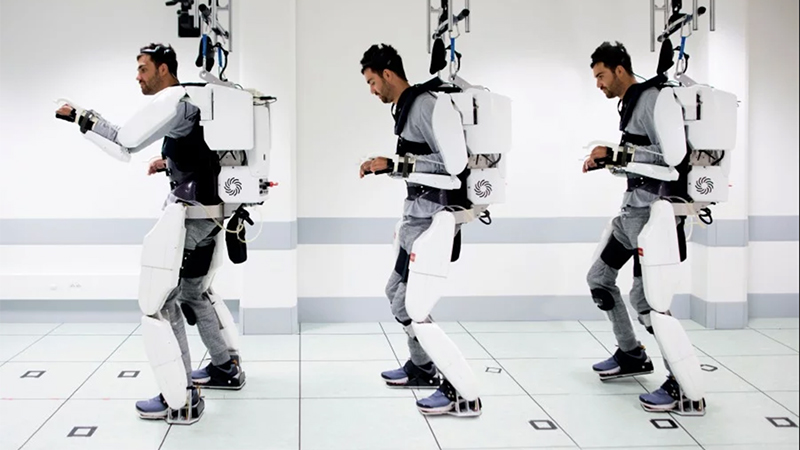
The setup included two wireless sensors on the brain, within the area controlling movement, and sixty-four electrodes. The setup recorded electrical impulses and sends commands to the computer. This allowed him to first learn to control the computer avatar, then turning the physical exoskeleton off and on.
While the technology is in its infancy, the group provided the proof it can work, which they hope will bring more attention to this endeavour.
Professor Alim-Louis Benabid, president of the Clinatec executive board told the BBC, “This is far from autonomous walking. He does not have the quick and precise movements not to fall.”
However, the research paper published in The Lancet Neurology Journal outlines the findings, stating, “Between June 12, 2017, and July 21, 2019, the patient cortically controlled a programme that simulated walking and made bimanual, multi-joint, upper limb movements with eight degress of freedom during various reach-and-touch tasks and wrist rotations, using a virtual avatar at home…or and exoskeleton in a laboratory. Compared with microelectrodes, epidural ECoG [electrocorticographic] is semi-invasive and has similar efficiency.”
Matt Cole has high regard for knowledge share. He has a desire to share critical thinking and information. With a Masters in Information Technology and a wide array of certifications, while not working full-time, he wishes to knowledge share through providing insight, information organization, and critical thinking skills.
#KnowledgeShare | Matt Cole | #infobyMattCole