
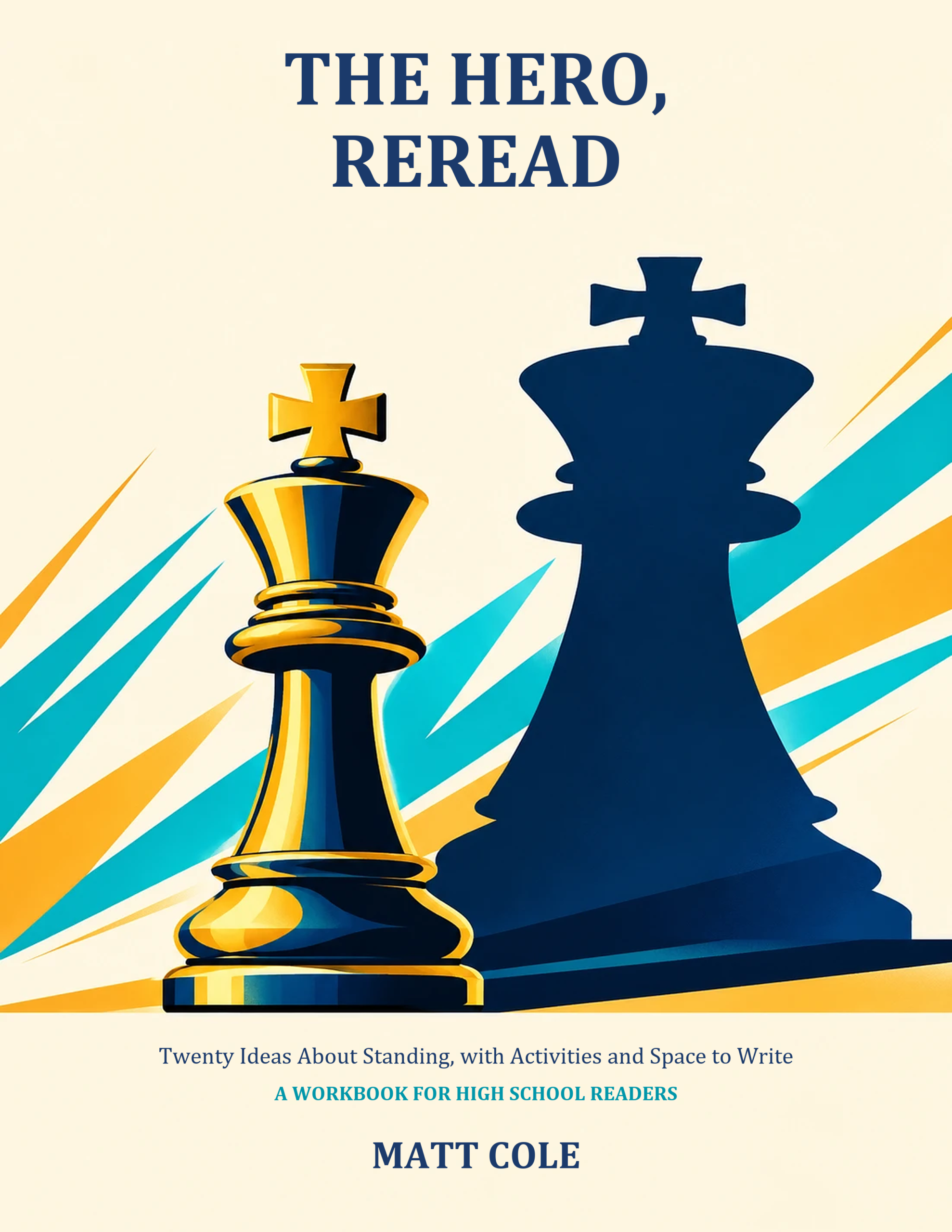
The Hero, Reread: What a 1637 Book Gets Right and Wrong About Reputation
Baltasar Gracián was a Spanish priest and writer. His 1637 book El Héroe (The Hero) was addressed to the royal court, and it works through twenty traits he called "Excellencies," each one a reason a person earns admiration. The people he holds up as models are kings, soldiers and courtiers.
That is not an obvious fit for a high school classroom. It turns out to be a useful one, for a reason the book never intended: almost every idea in it is something a teenager already runs into at school, on a team, in a job interview or in a group chat. And almost every idea in it can also be used on them.
The one idea worth rereading
Gracián's central bet is that respect follows visibility: people judge you by the part of you they can see, and that part is not always the best measure of what you can do. There is something to it. At school, at work and online, first impressions and reputation carry real weight.
The danger is how easily that logic turns into faking. So the workbook built on the book keeps a single distinction in front of students throughout:
- Withholding is deciding what to share, and when. Nobody is owed your whole story. This is ordinary privacy.
- Seeming is arranging things so people think you are stronger, more skilled or more certain than you really are. That crosses into deception.
Gracián blurs the two at times. The workbook keeps the first, flags the second, and does so in every chapter.
Example: "Don't Let Them Take Your Measure"
Chapter 1 takes up the first Excellency. Gracián's advice is to keep your limits hidden so that people credit you with more than they can measure. A 1652 English translation by Skeffington puts it this way: "If an able man would maintain his respect, he must suffer none to sound his bottom." His example is King Ferdinand of Aragon, who showed observers a glimpse and then closed the door.
The workbook asks what is useful in that and where it breaks:
- It works because an unknown invites a guess, and the guess tends to be kind. Picture an athlete who saves a few moves for later, or an applicant who leaves the interviewer curious.
- It fails when people have to rely on you. A lab partner, a teammate or a teacher has to know your real range.
- It fails when anyone can check. If a claim can be verified in a minute, mystery does not help.
The chapter closes on the same distinction: holding something back is privacy, while pretending to a skill you lack is a lie.
Example: "Should You Show a Flaw?"
Chapter 19 is the one where Gracián argues with himself. He describes a device: show a small, minor slip on purpose to feed the envy of rivals and defuse it. Then he rejects it. In the chapter's own summary, the planted flaw is "idle," because nature supplies enough flaws already.
Students will recognize the modern version at once: the "weakness" in a job interview that is really a strength in disguise, the staged mistake in a video so viewers feel closer, the confession that is a little too convenient. The workbook's verdict: owning a real limitation, at some cost to yourself, is honest; manufacturing one to steer how others feel is not.
Every move can be used on you
Each of the six parts of the workbook ends with a page called Who Is Doing This to You? Students read made-up scenarios and name the move being used: flattery, a fake deadline, a staged flaw, borrowed status. The point is not cynicism. It is that someone who can name a technique is harder to push around with it.
How it works in a classroom or at home
The workbook is built for one chapter a week, or for picking the chapters that fit an advisory, ELA, speech or character education plan. A few design choices matter for teachers and parents:
- Reflection, not grading. The questions are personal, so the teacher guide advises against collecting or scoring responses, and against making anyone share.
- A trusted adult comes first. When an activity calls for a partner, students pick someone they trust, and the book keeps pointing them to a trusted adult if anyone pressures or threatens them.
- It does not adopt Gracián's views. Some of them, such as ranking jobs by status, are 1600s attitudes. The workbook says so rather than endorsing them.
What is in the workbook
The Hero, Reread: High School Workbook on Reputation, Honesty and Influence is a printable PDF with:
- 20 chapters, each a two-page spread: a brief reading, then a write-in page with an activity, three questions (diagnose, decide, challenge) and a week-long experiment
- Six "Who Is Doing This to You?" pages built around Spot the Move scenarios, plus six checkpoint pages
- Twenty-statement self-rating snapshots at the start and end, so students can see what shifted
- A capstone page, "My One-Page Code"
- A 15-term glossary, a page on sources and method, and a notes page
- A separate teacher file with an answer key and a short guide for parents and teachers
Get the workbook on TpT: The Hero, Reread, $12
Watch the 2-minute overview: The Hero, Reread on YouTube
What this is not
No specific state standard is targeted, and the workbook makes no standards claim. Its scenarios are invented, not real cases. Its sources are a single Spanish text (the 1669 printing in modern spelling) and the 1652 English translation. Gracián's historical stories are retold as he gives them and were not checked against other histories. A teacher has not yet reviewed it, and students have not yet tested it.
Developed by Matt Cole, M.S. Information Technology, former Pocola Public School Board member.