Grade 3 Computer Science Curriculum: Every Oklahoma OAS-CS Standard, No Prep
Grade 3 Computer Science Curriculum: Every Oklahoma OAS-CS Standard, No Prep
Third grade computer science is where Oklahoma's standards stop leaning on "with guidance" almost entirely and start asking students to identify, compare, and reason on their own. It's also the grade where three brand-new ideas enter the curriculum for the first time — remixing existing programs, accessibility, and gathering different perspectives to improve a project. This bundle is a complete, no-prep Grade 3 computer science curriculum covering every Oklahoma Academic Standard for Computer Science at grade 3, in a format any teacher or homeschool parent can print and teach tomorrow.
What Oklahoma's Grade 3 CS Standards Actually Cover
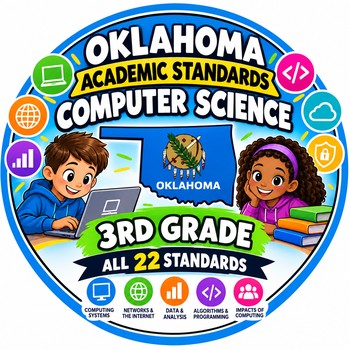
Oklahoma's grade 3 computer science standards span five strands, and this is the first grade where several subconcepts appear with no K-2 predecessor at all:
- Computing Systems (CS) — choosing the right computing system for a task (a step up from Grade 2's single "tech tool"), explaining how information flows through a computer's parts, and troubleshooting everyday tech problems using accurate terminology (3.CS.D.01, 3.CS.HS.01, 3.CS.T.01).
- Networks & the Internet (NI) — explaining how information travels over both wired and wireless connections, and — new this year — actually spotting inappropriate use of devices and networks, not just naming passwords as important (3.NI.NCO.01, 3.NI.CY.01).
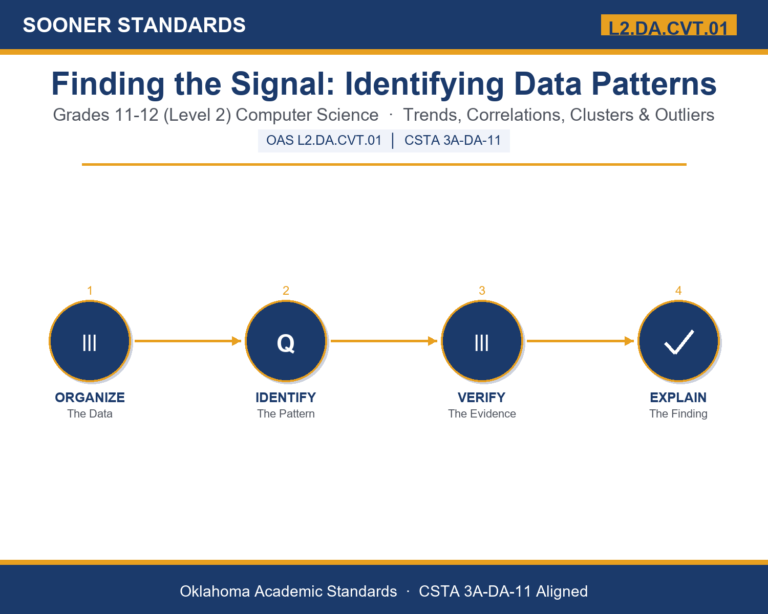
- Data & Analysis (DA) — a new framing of data formats and how information gets stored, collecting and organizing data into charts, and making real predictions from data patterns (3.DA.S.01, 3.DA.CVT.01, 3.DA.IM.01).
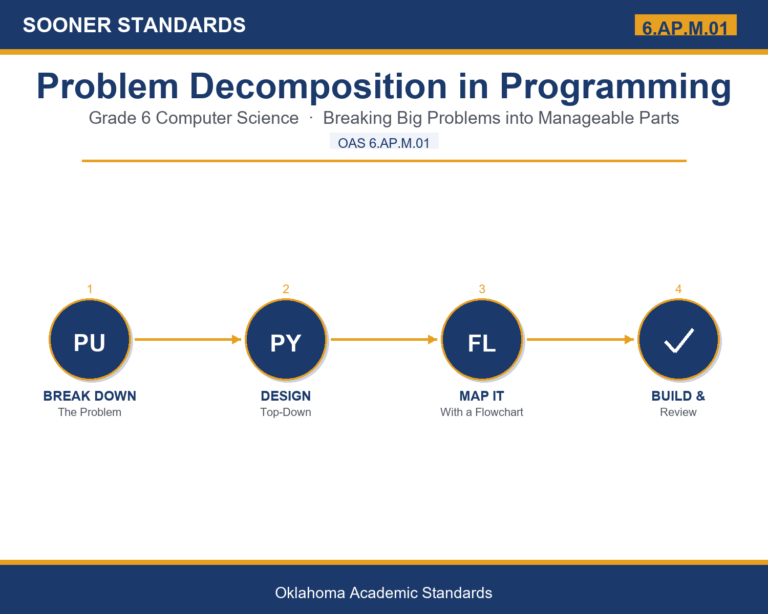
- Algorithms & Programming (AP) — the largest strand at grade 3: comparing multiple algorithms for the same task, working with variables, building programs with sequences, loops, and decisions, precise problem decomposition, and — brand new this year — modifying and remixing an existing program instead of always starting from scratch (3.AP.A.01, 3.AP.V.01, 3.AP.C.01, 3.AP.M.01, 3.AP.M.02, 3.AP.PD.01–04).
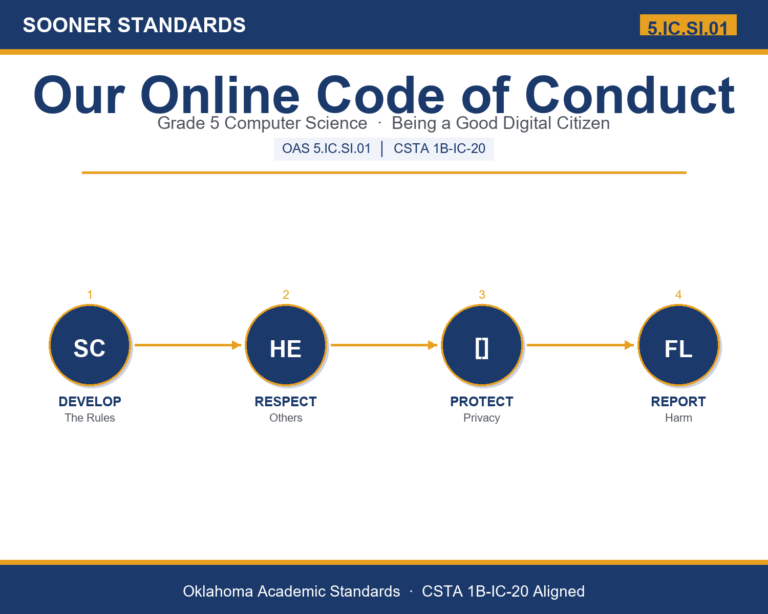
- Impacts of Computing (IC) — how technology and culture shape each other, plus two entirely new subconcepts: accessibility features built into devices, and considering different perspectives to improve a shared project — alongside an online code of conduct and a first real look at intellectual property rights (3.IC.CU.01, 3.IC.CU.02, 3.IC.SI.01, 3.IC.SI.02, 3.IC.SLE.01).
Three of these standards — remixing existing programs, accessibility features, and different perspectives on computational artifacts — have no Kindergarten-through-Grade-2 version at all. Oklahoma's own standards document confirms it: these ideas simply begin in third grade.
What's Inside the Grade 3 Computer Science Bundle
Every standard in the bundle comes as its own complete, standards-aligned unit — 22 resources, 748 total pages:
- No-prep lessons built for the grade-3 shift toward reasoning — short, plain sentences throughout, but the thinking asked of students moves from following a rule to explaining and comparing.
- A full content lesson for each standard, with built-in comprehension checkpoints.
- Activities — a group activity and an individual activity per unit, with all printable materials included.
- Assessments and answer keys — 6 multiple choice, 4 true/false, and 2 short-answer items tagged to the exact standard, with explanations and exemplar responses.
- Teacher guides — pacing, common misconceptions and how to fix them, discussion questions, and differentiation for support, ELL, and extension.
- Family connection letters and certificates — plain-language pages that bring the learning home, perfect for homeschool.
- A free bonus resource pack — a Standards at a Glance table, a full-year pacing calendar, an answer key compilation, and a standard mastery rubric compiled across all 22 units, for fast administrator walkthroughs and grading consistency.
New This Year: Remixing, Accessibility, and Intellectual Property
Grade 3 is where three ideas show up for the first time in Oklahoma's CS progression. Students learn to remix — taking an existing program and thoughtfully changing it, rather than always building from a blank page. They're introduced to accessibility, noticing how real devices already include built-in features like text-to-speech, captions, and zoom, and thinking about who each one helps. And they take a first real look at intellectual property, learning that a photo, song, or piece of code usually belongs to someone, and that using someone else's work respectfully means asking permission or giving proper credit — a thread that runs through both the Algorithms strand (giving credit in code) and the Impacts of Computing strand (digital data and copying rights). None of this requires prior coding experience — every idea is taught with concrete, everyday examples third graders already recognize.
Aligned to Oklahoma — and Ready for Any Classroom
Every unit is built directly from the official Oklahoma Academic Standards for Computer Science (February 2023), with the standard text verified rather than paraphrased from memory, and cross-walked to its matching CSTA Grades 3-5 (1B) indicator — including two honest gaps (data formats/storage and the online code of conduct) where Oklahoma's own standards go beyond what CSTA's 1B band covers, clearly marked rather than force-matched. The materials are print-ready and LMS-ready, work fully offline, and collect no student data — so they fit a one-device classroom, a full lab, or a homeschool table equally well.
See the Bundle in Action
Get the Complete Grade 3 CS Curriculum Bundle
Skip months of lesson-building and cover your entire year of Oklahoma Grade 3 computer science with one no-prep resource.
Get the Grade 3 Computer Science Bundle on Teachers Pay Teachers →
Every Sooner Standards resource is built directly from the official Oklahoma Academic Standards for Computer Science (February 2023) — standard text verified, never paraphrased from memory. Aligned to the Oklahoma Academic Standards for Computer Science; not a state-adopted or state-approved curriculum.