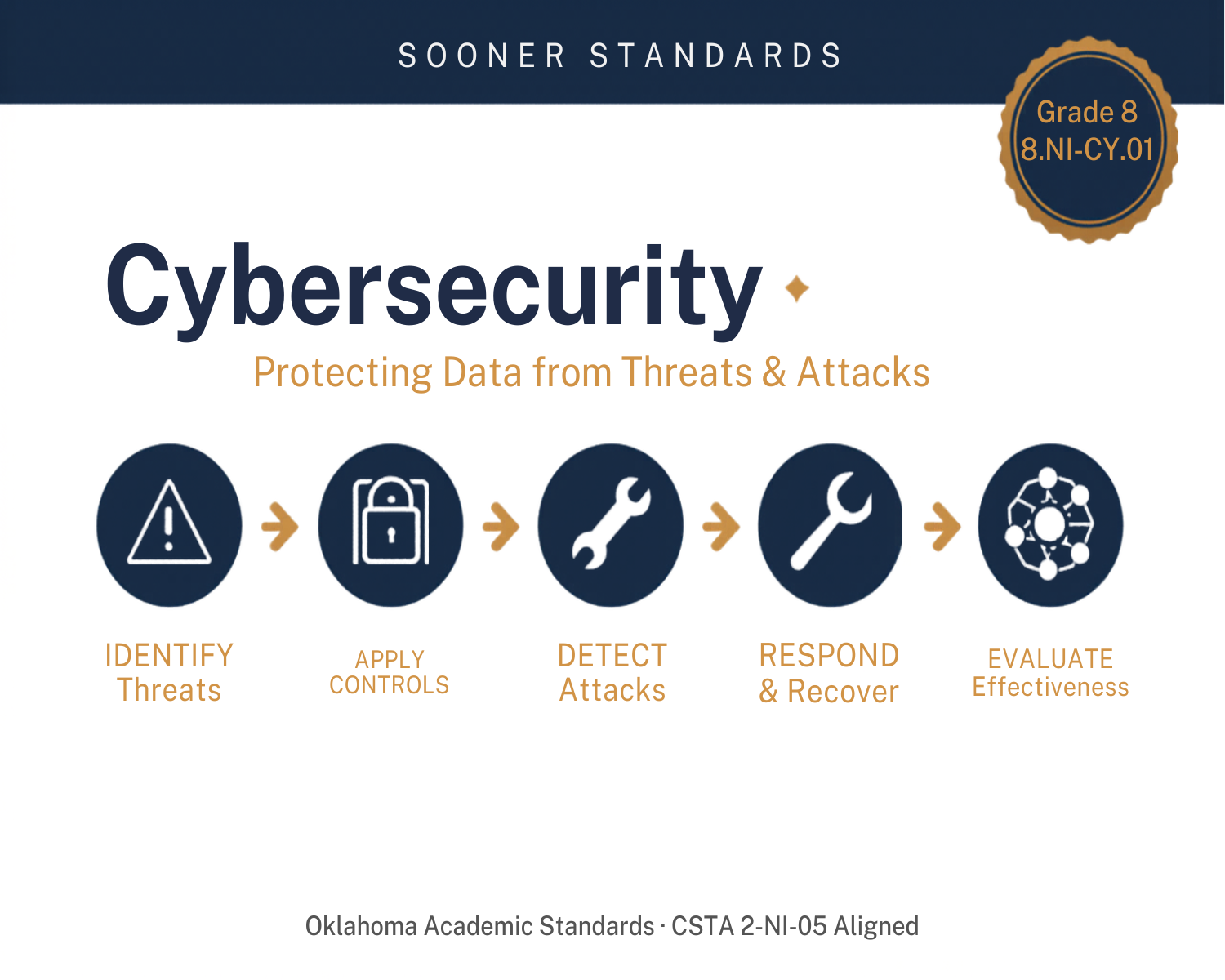
Cybersecurity: Protecting Data from Threats and Attacks
Teaching Cybersecurity in Grade 8: Oklahoma Standard 8.NI.CY.01
Student academic records, medical histories, financial accounts, and private communications all exist as digital information — stored on servers, transmitted across networks, and accessed through connected devices. Oklahoma's standard 8.NI.CY.01 asks eighth graders to understand why that makes electronic data such a valuable target: evaluating physical and digital procedures that could protect it, and explaining the impacts of cybersecurity threats and attacks. This post walks through what the standard means, the vocabulary students need, and a few discussion starters you can use tomorrow.
What Does Standard 8.NI.CY.01 Actually Ask?
Evaluate physical and digital procedures that could be implemented to protect electronic data/information; explain the impacts of cybersecurity threats and attacks. — Oklahoma Academic Standards for Computer Science (February 2023)
In plain language: students need to know both sides of cybersecurity — what protective measures actually work, and what real damage happens when those protections fail.
Key Vocabulary Students Will Learn
Cybersecurity, Threat, Malware, Phishing, Firewall, Encryption, Authentication, Authorization, Vulnerability, Patch, Backup, Access Control, Social Engineering, Multi-Factor Authentication, Data Breach
This fifteen-term vocabulary set gives students the precise language to describe both attacks (malware, phishing, social engineering) and defenses (firewalls, encryption, multi-factor authentication).
What's Inside the Lesson
The content reading opens by establishing just how valuable electronic data has become — for schools, businesses, governments, and individuals alike. Student academic records, medical histories, financial accounts, private communications, and intellectual property all exist as digital information, which makes that data a persistent target for anyone seeking to access, steal, manipulate, or destroy it. The reading builds from there into the specific threats and the specific protections that address them.
Discussion Starters You Can Use Tomorrow
- Why might a school's academic records be a valuable target, even though they aren't financial information?
- What's the difference between a technical attack (like malware) and a social attack (like phishing)? Which do you think is harder to defend against?
- If you were setting up security for a school computer lab, what's one physical procedure and one digital procedure you'd put in place?
Where This Leads
Students who understand cybersecurity threats and defenses are building genuine digital literacy for a world where nearly every important record about them — academic, medical, financial — exists as data that has to be protected.
See the Unit in Action
Get the Complete 8.NI.CY.01 Unit
I built a complete, no-prep unit for this standard — Cybersecurity: Protecting Data from Threats and Attacks — across 28 ready-to-print pages:
- Vocabulary reference — all 15 terms with definitions and real-world examples
- Full content reading with embedded comprehension checkpoints
- 10-question assessment (6 multiple choice, 4 true/false) with a complete answer key and explanations
- Group activity — "Security Audit: Evaluate the School's Defenses"
- Individual activity — "Cybersecurity Incident Analysis"
- Crossword and word search built from all 15 vocabulary terms (with answer keys)
- Standards alignment verification page
- Cybersecurity Controls Reference (separate printable)
- Threat and Control Matrix (separate printable)
Get Cybersecurity on Teachers Pay Teachers →
Every Sooner Standards resource is built directly from the official Oklahoma Academic Standards for Computer Science (February 2023) — standard text verified, never paraphrased from memory.